
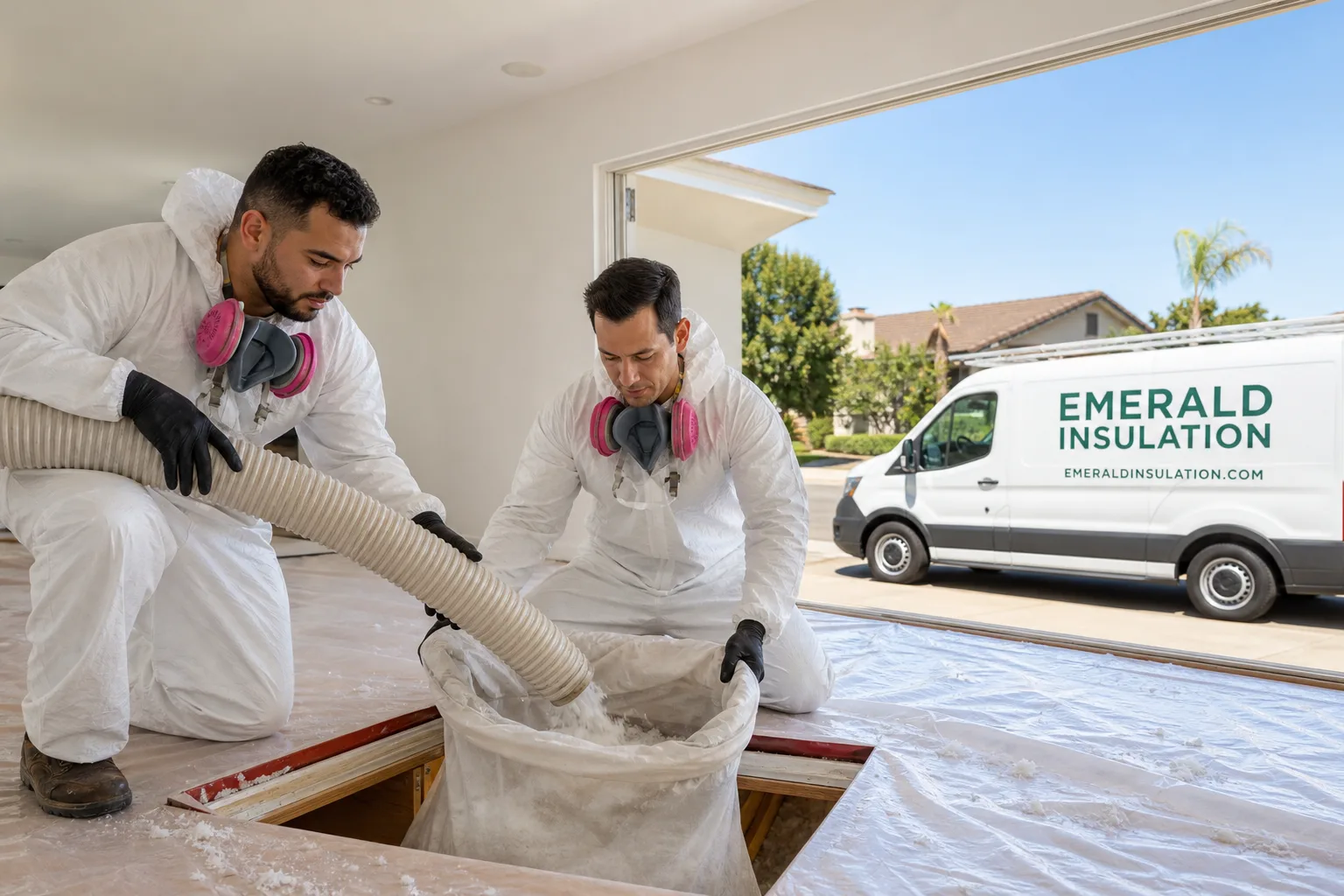
Fast, Reliable Spray Foam Insulation Across Villa Park
Spray foam insulation in Villa Park typically costs between $2,800 and $7,500 for an attic retrofit, depending on square footage, roof pitch, and how many separate attic zones your home has. Most Villa Park jobs are completed in one to two days because our crews know the housing stock here and arrive prepared for the specific conditions. If your energy bills climb every summer and the upstairs rooms bake through Santa Ana heat waves, air-sealing with spray foam is usually the fix. Call us at (855) 490-8655 and we’ll walk you through what your house actually needs.
Why Emerald Insulation Is Villa Park’s Preferred Spray Foam Insulation Company
Villa Park isn’t a tract-home community. Every street off the 92861 zip code has custom-built ranch estates, split-levels, and homes that have been added onto three or four times since the Johnson administration. We’ve worked in enough of them to know that no two attics are framed alike, and that what works on a flat-lot home on Mesa Drive won’t translate to a hillside property near the Villa Park Dam side of town.
Our reputation with Villa Park homeowners comes from treating every job as a diagnostic first. We don’t walk in with a standard package and hope it fits. Noel Cartagena, who leads Emerald Insulation, built the company on the idea that insulation material decisions should follow the house, not the other way around. Homeowners here tend to be research-driven and they compare materials carefully, which is exactly how we like to work.
When you call about a drafty addition, a hot second story, or original 1960s fiberglass that’s settled flat, we’ll ask about your ceiling planes, your roof pitch, and whether you’re on the sloped side toward Santiago Creek. Those details matter in Villa Park more than almost anywhere else in Orange County.
Spray Foam Attic Insulation in Villa Park
Spray Foam Attic Insulation in Villa Park is rarely a simple matter of hose-in, spray, done. The attic assemblies here run the range from standard flat-framed ceilings to low-clearance split-levels over vaulted living rooms, and nearly every original home from the 1960s and 1970s still carries settled fiberglass batts that stopped doing their job years ago. A full attic spray foam job in Villa Park runs $3,200 to $6,800 on average, with split-level and hillside homes at the higher end because of access time and the number of ceiling planes involved.
What makes this work different here is the geometry. On the Villa Park side toward Villa Park Dam, sloped lots mean the attic follows the terrain, creating knee-wall cavities, triangular rafter runs, and transitions between ceiling planes that a flat-lot tract house never has. We foam those zones in sequence, sealing the gaps at each plane transition so hot attic air doesn’t find a way back into the living space.
The performance difference is real. Closed-cell foam at two inches can cut radiant heat gain through the roof deck by a substantial margin during Santa Ana conditions, and open-cell foam in the 5- to 6-inch range does the same while staying vapor-permeable. For Villa Park homeowners who’ve lived with upstairs bedrooms that stay 80 degrees at midnight in July, the after-difference is typically night-and-day.
Low-Clearance and Split-Level Attics
Some of the hardest access work we do in Villa Park is in attics with 24 to 36 inches of clearance at the peak and less at the eaves. Our crew works in those spaces regularly, using smaller rigs and hose extensions that let us foam rafter bays without tearing out ceilings. We seal the knee-wall cavities first, then work outward along the roofline. The tight triangular runs that get skipped by generalists are where heat finds its way back in, so we spend the extra time on those transitions.
Cathedral and Vaulted Ceiling Assemblies
If your vaulted ceiling has no attic access above it, spray foam may still be applied from the exterior or by opening a small section of ceiling and foaming through. We see this most often in living rooms and master suites on 1960s estates. Foaming those rafter bays creates a continuous thermal barrier that old batt insulation could never provide, and it’s often the difference between a living room you can enjoy in August and one you abandon for three months a year.
Spray Foam Wall Insulation in Villa Park
Spray Foam Wall Insulation in Villa Park typically happens during a remodel, a room addition, or when we’re opening a wall for other repairs and find the cavity empty or filled with degraded material. Wall spray foam in Villa Park runs $2,800 to $5,200 for a typical single-room or partial-home retrofit, and $7,000 to $14,000 for whole-home wall work during a gut remodel. Prices reflect the number of wall cavities, stud bay depth, and whether we’re working from the inside or outside.
Many Villa Park homes from the 1960s through the 1980s have little or no wall insulation behind the original drywall or plaster. Builders in that era didn’t prioritize it, and Orange County’s mild winters meant nobody noticed until energy costs and comfort expectations changed. When we open those walls, the difference between an empty stud bay and one filled with closed-cell foam is dramatic. Closed-cell adds structural rigidity and acts as an air barrier, which is why we recommend it for exterior wall cavities in older custom homes.
Open-cell foam is a better match for interior walls where sound control matters, and for walls where the budget doesn’t stretch to closed-cell. In Villa Park, where homes sit on half-acre lots and neighbor noise isn’t the primary concern, the main driver is usually thermal and air-sealing performance. We match the foam type to the wall’s actual role in the envelope.
Exterior Wall Retrofits During Remodels
If you’re already stripping a room down to studs, that’s the moment to foam the exterior walls. We coordinate with your general contractor and schedule the spray once framing and rough-in are complete. On the hillside side of Villa Park, we often find rim joist gaps and band joists on the lower level that were never insulated and let air move freely between floors. Sealing those with Spray Foam Insulation closes a major leak point in split-level homes.
Rim Joist and Band Joist Sealing
Rim joists in Villa Park homes are often the most overlooked air leak in the whole structure. The band joist where your floor meets the foundation or the next story is a direct path for outside air into the floor cavities. Spray foaming those bands takes a few hours and cuts the drafts you feel along baseboards and exterior walls. We recommend closed-cell for rim joists because it handles moisture better in the crawlspace-to-living-space transition.
Trusted Brands We Service in Villa Park
We carry Owens Corning products because their fiberglass legacy is strong and reliable, but we pair it with Icynene and Demilec spray foam systems because the chemistry of those foams handles the hot, dry roof conditions in inland Orange County better than a single-material approach ever could. Having multiple brands means we’re not tied to one supplier’s story. For Villa Park customers, that translates to faster turnaround because we keep local stock on hand and don’t have to wait on a distributor in Anaheim or Santa Ana. We also stock Rockwool for jobs where fire resistance and sound control are part of the ask, which comes up in Villa Park when homeowners retrofit attached garages or interior media rooms.
Common Spray Foam Insulation Problems We See in Villa Park Homes
- Settled original fiberglass batts under new eaves. The 1960s and 1970s homes off the main roads into Villa Park were built when R-11 batts were the standard. We routinely find those batts compressed flat under roof decking, leaving ceiling planes that radiate heat into the rooms below. Foam applied over settled batts without air-sealing first doesn’t solve the problem, so we address the gaps first.
- Unsealed knee-wall cavities on sloped lots. Homes on the Santiago Creek side have knee walls where the roofline meets a sloped ceiling transition. Those little triangular spaces are almost never insulated in original construction, and they leak heat like an open window. We see this on a high percentage of hillside Villa Park homes we inspect.
- Additions stacked over decades with isolated attic zones. It’s common to see a 1968 original home with a 1985 bump-out and a 2001 garage conversion, each with its own attic section. If foam was ever applied, it usually went into only one zone. The transitions between those zones become the weak spot. We map the zones and foam them as a system, not a patch job.
- Open-cell foam sprayed too thin over radiant heat sources. Open-cell has real value in Villa Park attics, but sprayed at 2 or 3 inches it doesn’t stop the roof deck from radiating heat down into the living space. We spec minimum depths based on each roof plane’s sun exposure, and on south- and west-facing slopes in Villa Park that often means 5 to 6 inches of open-cell or 2 inches of closed-cell.
Pricing for Spray Foam Insulation in Villa Park, CA
Here’s what we quote most often in Villa Park, based on jobs completed in the 92861 zip code:
- Attic rafter bay spray foam (open-cell, 5.5 inches): $3,000 – $5,200 for a 1,200 – 1,800 sq ft attic
- Attic rafter bay spray foam (closed-cell, 2 inches): $3,800 – $6,500 for the same footprint
- Knee wall and transition sealing: $900 – $2,200 depending on linear feet and access clearance
- Single wall cavity retrofit during remodel: $1,400 – $2,800 per room
- Whole-home wall spray foam during gut remodel: $7,000 – $14,000
- Rim joist sealing (full perimeter): $1,100 – $2,600
Split-level and hillside attics on the Dam side of Villa Park run toward the higher end because access is slower and the crew works multiple ceiling planes. We give you a written estimate before work starts, at no charge. Call (855) 490-8655 and we’ll schedule a walk-through.
We Also Serve Cities Near Villa Park
Emerald Insulation works throughout inland Orange County, including Orange, North Tustin, Placentia, and Anaheim. If you’re just across the Villa Park line in the Orange hills or over in North Tustin with a similar vintage custom home, we cover those areas with the same diagnostic-first approach and local material stock.
Serving Villa Park, CA — Our Local Coverage Area
We’re based in the Villa Park area and know this community well. Use the map below to see our service coverage — if you’re nearby, we can almost certainly help.
FAQs About Spray Foam Insulation in Villa Park
Yes, and we do it regularly in Villa Park. Low-clearance attics take longer because the crew works with smaller rigs and shorter hose runs, but the foam goes in the same way. We seal knee-wall cavities first, then work along the rafter bays. On a ranch-style estate near the Santiago Creek side of town, our crew climbed into just such an attic where original fiberglass batts had settled and pulled away above a vaulted living room, leaving a hot ceiling plane for years. We sealed the knee-wall cavities and foamed the rafter bays in the tight triangular runs the previous retrofit had simply skipped, mixing open-cell foam over the old batt lines and leaving the cathedral section with a continuous, taped-off barrier. The homeowner noticed the upstairs bedrooms stopped baking through the Santa Ana heat that August. Call (855) 490-8655 if you’d like us to assess your attic’s access and clearance.
Usually yes, at least in the areas where we’re foaming. Settled batts that are compressed and dirty don’t provide meaningful R-value, and leaving them under foam can trap moisture in certain conditions. We remove the old material in the zones we’re treating, air-seal the ceiling plane, then apply foam. In some cathedral sections where removal would require opening the ceiling, we may foam over the existing batts with open-cell to avoid demolition, but we’ll discuss that with you before doing it.
Yes, attic and roof deck insulation matters more in Villa Park than wall insulation for most homes. The dominant heat load is from the sun beating on the roof, not ambient air infiltrating through walls. A well-foamed attic with sealed ceiling transitions cuts cooling demand substantially. Wall foam helps on top of that, especially on the west and south sides, but attic work delivers the more noticeable summer difference. That said, the two work together, and on sloped hillside homes the knee walls and rim joists are part of the attic-side package.
We look at three things: the condition of the existing material, the air leakage at ceiling transitions and knee walls, and whether the home has multiple attic zones from decades of additions. If the original fiberglass is settled and the knee walls are unsealed, patching and topping off won’t change the comfort picture. Retrofit with spray foam addresses the air gaps and the thermal barrier together. If an addition was built in the 1990s and already has decent batts, we might only foam the transitions and leave the rest. Ground truth matters, so we walk the attic before recommending anything. Estimates are free, and we’ll show you what we see.
In most cases, yes, every attic zone needs to be addressed as part of the same air-sealing plan. The problem with add-on construction is that each addition typically has its own attic section, and the gaps between sections leak air. Foaming only the original zone leaves the bump-out unsealed and the transition gap open, which means hot attic air still finds a path into the conditioned space. We map all the zones, identify the gaps, and foam them as a system. The goal isn’t just more insulation, it’s a continuous barrier.
Emerald Insulation matches the material and method to your house, not the other way around. If you’re tired of hot upstairs rooms, drafty floors, and energy bills that climb every summer, call (855) 490-8655 for a free estimate. We’ll walk your attic, map the zones, and give you a straight answer about what your Villa Park home actually needs.
Written by Noel Cartagena, Owner at Emerald Insulation, serving Villa Park and the surrounding Orange County communities.