
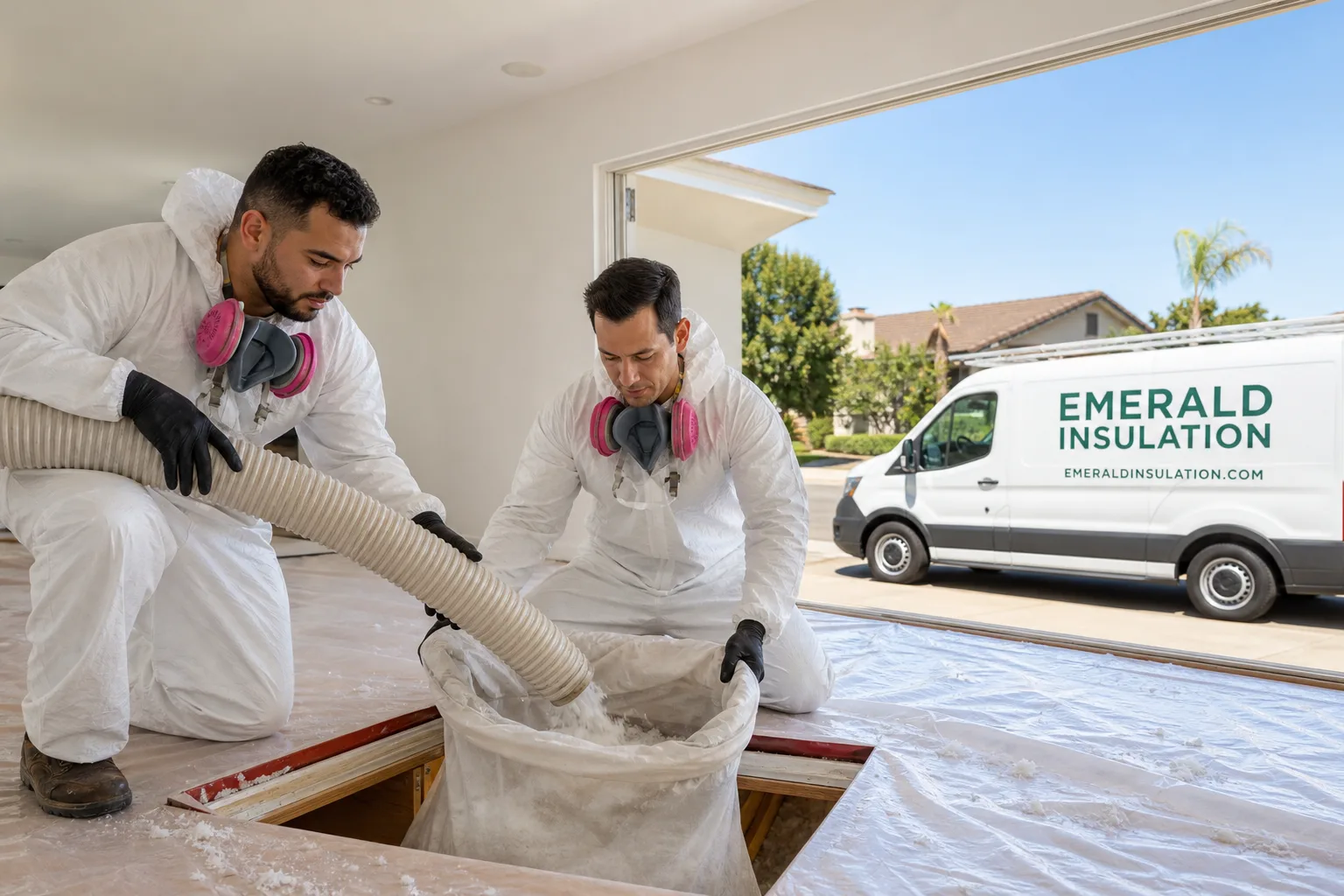
Fast, Reliable Spray Foam Insulation Across Orange
Spray foam insulation in Orange typically runs $2.50 – $6.50 per square foot installed, with most attic projects in the 92866 and 92867 zip codes landing between $3,800 and $9,200 depending on open-cell versus closed-cell and the condition of the existing space. We’re in Orange weekly, and our crews know the difference between a 1920s Old Towne bungalow attic and a 1968 east-side tract home ceiling before we even open the hatch. Call (855) 490-8655 and we’ll schedule a free attic assessment, usually within two to three business days.
Why Emerald Insulation Is Orange’s Preferred Spray Foam Insulation Company
We work differently than the generalist contractors who treat spray foam as one product in a long menu. Noel Cartagena built Emerald Insulation around a single idea: match the material to the house, not the other way around. In Orange, that means recognizing that a home off East Chapman Avenue has completely different retrofit needs than a house in the tracts north of Katella. We carry Icynene and Demilec spray foam systems because they cover both ends of the performance spectrum, and we’re certified installers for both.
Most of our Orange work comes from referrals in Old Towne and the neighborhoods around Santiago Canyon Road. Homeowners here have done their research. They know about air sealing and R-values. What they want is someone who can look at a 1940s attic with plaster walls and tell them honestly whether open-cell foam makes sense, or whether they should address the knob-and-tube wiring first. That’s the conversation we have every week in Orange, and it’s why our customers tend to recommend us to their neighbors.
Open Cell Spray Foam in Orange
Open cell spray foam is the workhorse for attic retrofits in Orange, especially in the older homes around Old Towne and the mid-century tracts east of the 55. It expands to fill irregular cavities, seals air leaks at the roofline, and stops the stack effect that pulls hot attic air down into living spaces during Orange’s summer months. We apply it to the underside of the roof deck, converting vented attics into conditioned spaces that stay within a few degrees of the living area below. This matters in Orange because those 90°F-plus days from July through September turn uninsulated attics into 140°F ovens that force your AC to run constantly.
When Old Towne Homes Benefit Most
Historic attics in Orange’s pre-WWII housing stock are almost always under-insulated. Open-cell foam works well here because it’s lighter than closed-cell and doesn’t load the old framing with excess weight. It also allows moisture to diffuse, which is safer for original redwood sheathing. But there’s a catch: if your home still has active knob-and-tube wiring, we have to address that before spraying. Foam encasing live knob-and-tube creates a fire hazard. We test circuits first, isolate or rewire as needed, then spray.
Typical Open-Cell Costs in Orange
A standard open-cell roof deck application in Orange runs $2.50 to $4.00 per square foot installed. For an average 1,200-square-foot attic, that’s roughly $3,000 to $4,800 before any electrical remediation. It’s not the cheapest option, but in a 1920s Craftsman with original single-pane windows and no wall insulation, air sealing the attic is the single highest-impact retrofit you can make.
Spray Foam Insulation Contractors in Orange
Spray foam insulation contractors in Orange need to understand the city’s split personality: historic preservation rules on one side of town, 1960s tract construction on the other. We’ve worked in both for years. The east-side homes built between 1960 and 1975 typically have settled fiberglass batts in the attic and zero air sealing at the top plates. The Old Towne properties have different issues entirely: minimal insulation, fragile plaster, and original wiring that predates modern electrical codes. A contractor who only knows one of these housing types will get the other one wrong.
What We Check Before Quoting
Every spray foam estimate in Orange starts with an attic inspection. We look at the existing insulation depth, ventilation configuration, roof deck condition, and whether any knob-and-tube wiring is still active. In historic homes, we also flag any required city design review before we plan exterior penetrations. Then we give you a written quote with material type, depth, and R-value clearly stated. No vague “we’ll see what happens” pricing.
Retrofit vs. Repair Decisions
Most Orange homeowners we meet don’t have a “failed” insulation system so much as an inadequate one. The question isn’t usually whether to repair something broken. It’s whether to remove old fiberglass batts and start fresh with spray foam, or to leave what’s there and air-seal on top. In most east-side tract homes, we recommend removing the old batts entirely. They’ve settled, they’re dusty, and they’re doing almost nothing. Spray foam applied directly to the drywall and roof deck gives you a continuous air barrier that batts can never match.
Trusted Brands We Service in Orange
We stock Icynene and Demilec spray foam systems because they’re the two manufacturers we trust for different applications. Icynene’s open-cell foam is our go-to for attic roof decks and historic homes where moisture diffusion matters. Demilec’s closed-cell products deliver higher R-value per inch and add structural rigidity, which makes them ideal for rim joists and garage ceiling applications. We also work with Owens Corning and Rockwool products when a hybrid approach makes more sense than full spray foam. The point isn’t brand loyalty. It’s matching the material to what your Orange home actually needs, and we carry enough options to do that honestly.
Common Spray Foam Insulation Problems We See in Orange Homes
- Foam sprayed over active knob-and-tube wiring. This happens when a contractor skips the electrical inspection. Live wiring encased in foam can overheat and create a fire hazard. We test and isolate every circuit before we spray in homes built before 1950.
- Too-thin foam in east-side tract attics. If open-cell foam is applied at less than about 3.5 inches on the roof deck in Orange’s hot summer climate, it won’t hit the R-38 recommended for zone 3 and condensation can form on the underside of the sheathing. We spec the full depth every time.
- Plaster cracks during wall injection. Old Towne’s plaster walls are fragile. Aggressive expansion foam can blow them out. We use low-expansion open-cell for wall retrofits and drill small, patched holes to minimize visible damage.
- Roof deck moisture trapped by closed-cell foam in the wrong application. In homes with existing roof leaks or no ridge ventilation, closed-cell foam can hide moisture problems until they rot out the sheathing. We inspect the deck first. If moisture is present, we fix the leak before we foam.
Pricing for Spray Foam Insulation in Orange, CA
For Orange specifically, here’s what you’re looking at. Open-cell attic foam runs $2.50 – $4.00 per square foot installed. Closed-cell runs $4.50 – $6.50 per square foot. A rim joist package for a typical 1960s ranch on the east side costs $1,200 – $2,400. Garage ceiling spray foam, which is popular in Orange for converted garages and workshops, typically lands between $1,500 and $3,500. If you’re in Old Towne and need knob-and-tube remediation first, add $800 – $2,500 for electrical work depending on scope. These are real ranges from actual Orange jobs. Your exact number depends on attic size, foam depth, and access. We give free, written estimates with no pressure, and Noel stands behind every quote. Call (855) 490-8655 to schedule yours.
We Also Serve Cities Near Orange
Our crews cover Orange and the surrounding communities daily. You’ll find us in Villa Park attics, North Tustin garages, Tustin condos, and Anaheim homes every week. If you’re anywhere in the central Orange County corridor and need Spray Foam Insulation done right, we can get to you fast.
Serving Orange, CA — Our Local Coverage Area
We’re based in the Orange area and know this community well. Use the map below to see our service coverage — if you’re nearby, we can almost certainly help.
FAQs About Spray Foam Insulation in Orange
Yes, but only after the wiring is addressed. Spray foam and live knob-and-tube don’t mix. The foam traps heat around the old conductors, which can cause the insulation on the wires to break down and arc. We test the circuits first, then isolate or rewire as needed before applying Icynene open-cell foam. We recently sprayed a 1920s Craftsman bungalow off East Chapman Avenue this exact way: rerouted the active circuits, then foamed the roof deck and brought the attic to current code. Call (855) 490-8655 if your Old Towne home still has original wiring and you want an honest assessment.
It depends on what the job involves. If the spray foam work is entirely interior, such as attic or rim joist application, Orange’s design review typically doesn’t apply. If you’re planning exterior wall foam that requires new stucco or siding changes visible from the street, you may need to go through the city’s historic preservation process. We can tell you which side of the line your project falls on during the estimate visit.
Spray foam outperforms fiberglass batts in Orange’s climate by a wide margin. The key difference is air sealing. Batts filter air but don’t stop it. Spray foam creates a continuous air barrier, which means your attic stops pulling 140°F air down into the house during July and August heat waves. Most of our Orange customers see 20 – 30% reductions in cooling costs after a proper attic foam retrofit, and the upstairs rooms stop feeling like a different climate zone from the rest of the house.
For the east-side tract homes built in the 1960s and 70s, we almost always recommend open-cell spray foam on the roof deck with the old fiberglass batts removed. Open-cell gives you the air sealing you need while allowing moisture to escape, which matters with older roof decks that may not have modern ridge vents. Closed-cell is overkill for most attic applications in Orange unless you’re adding structural strength or insulating a crawlspace or rim joist. We’ll show you the difference during the walkthrough.
Not if it’s applied correctly. The concern with historic redwood siding is moisture trapping. If you spray closed-cell foam into walls behind original siding, you eliminate the wall’s ability to dry to the exterior. We use open-cell foam for wall retrofits in Old Towne specifically because it remains vapor-permeable, and we drill small holes that are easy to patch. The original siding stays intact and continues to breathe the way it was designed to. Call (855) 490-8655 for a free estimate and we’ll walk you through exactly how the foam goes in and what it means for your home’s original materials.
Written by Noel Cartagena, Owner at Emerald Insulation, serving Orange, CA and surrounding communities.