
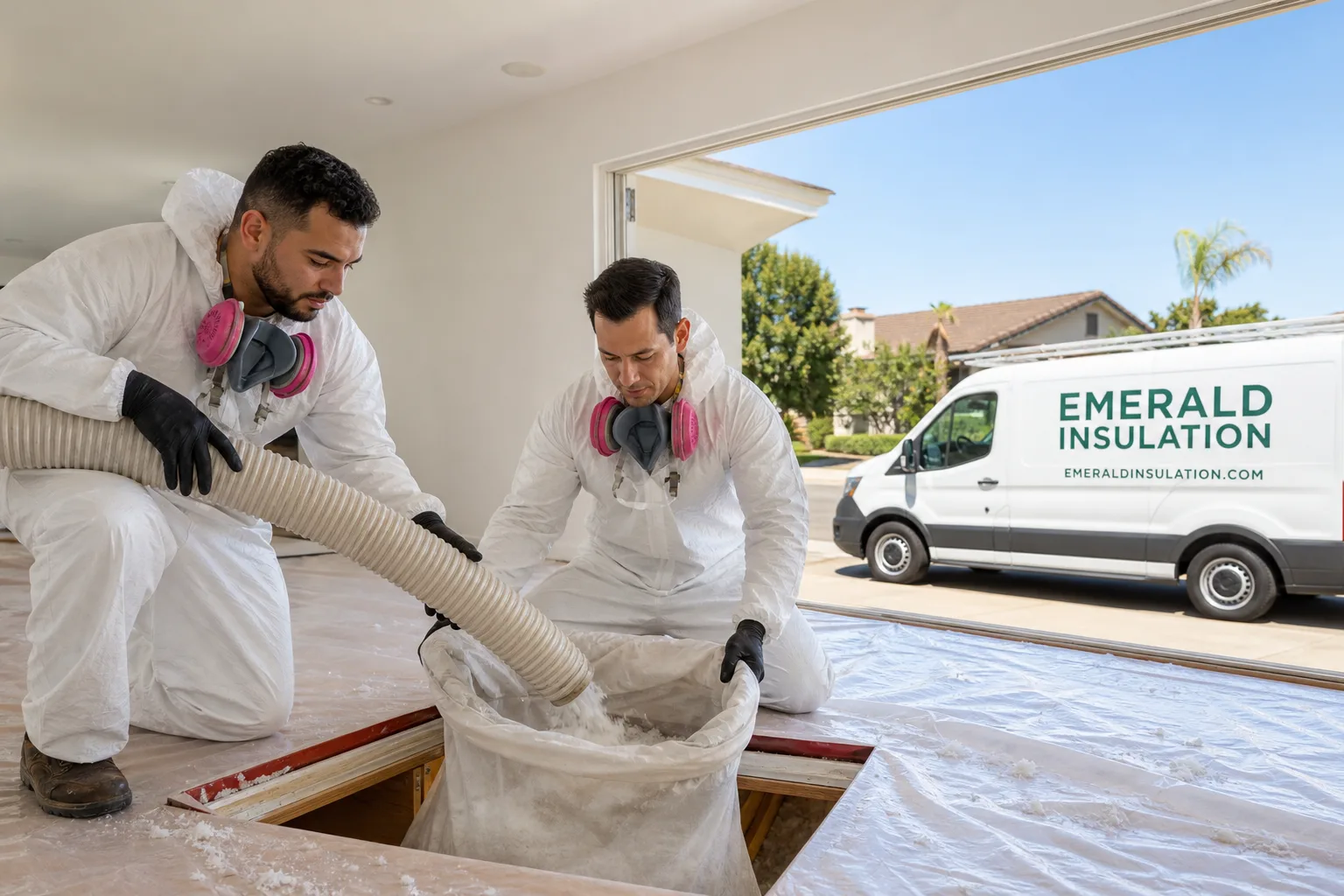
Fast, Reliable Spray Foam Insulation Across Costa Mesa
Spray foam insulation in Costa Mesa does two jobs that fiberglass batts in a 1950s stucco shell were never designed to do: it seals the rim joists and garage cavities where the marine layer pushes damp air every morning, and it stops the slow corrosion cycle that attacks framing fasteners, springs, and hinges years earlier than inland homes ever see. We work the 92626, 92627, and 92628 ZIPs regularly, and our crews know what a Mesa Verde tract house built in 1959 actually looks like inside its walls. If you’re dealing with fog-morning sweating on garage ceilings, drafty rooms, or original batts that have slumped and gone damp, call (855) 490-8655 and we’ll come look at the shell itself, not just sell you foam.
Why Emerald Insulation Is Costa Mesa’s Preferred Spray Foam Insulation Company
We’ve done enough jobs in the older neighborhoods off Harbor Boulevard and Mesa Verde Drive to know that Costa Mesa houses hide moisture problems behind stucco that a quick blow-and-go crew would never find. Our lead, Noel Cartagena, has built the company around the idea that foam is only as good as the prep behind it. We pull wet batts, we air-seal top plates, and we check that the attic vents on a pre-Title 24 roof aren’t about to get choked by the very foam we install.
Because we carry both Icynene and Demilec product lines, we can match open-cell or closed-cell to what each Costa Mesa home actually needs. A garage conversion off the Eastside with a rust-prone steel track gets a different spec than a crawl space under a post-war bungalow holding morning fog against its floor joists. We’re brand-agnostic, which in practical terms means the recommendation comes from your house, not from what’s left in the warehouse.
Response time to Costa Mesa from our Irvine base runs tight; we can usually have a crew on site within a business day, and we quote free over the phone after a short walkthrough. The point is simple: better insulation means lower bills and a more comfortable home year-round, especially this close to the water.
Rim Joist Spray Foam in Costa Mesa
Rim joist spray foam is the highest-priority upgrade we recommend for Costa Mesa’s 1950s and 60s tract homes, because the rim joist is where the marine layer’s moisture enters the wall cavity first. In the 92626 and 92627 ZIPs especially, we find unsealed rim joists with original fiberglass stuffed loosely between the floor framing. That fiberglass soaks up damp air like a sponge, and the framing nails rust out over time. Closed-cell foam applied directly to the rim joist stops the air movement, acts as a vapor barrier, and keeps the garage cavity dry enough that door hardware stops corroding prematurely. A typical rim joist spray foam job in Costa Mesa runs $800 to $1,900 depending on linear footage and how much old batt removal is involved.
Closed-Cell for Garages and Rim Bands
We carry Icynene and Demilec closed-cell systems because they cure to about 2 inches of R-7 per inch and double as a vapor retarder. For a Costa Mesa garage wall that sweats on foggy mornings, that dual function matters more than the R-value. The foam seals the plane where damp air gets in.
If your garage door springs and hinges are rusting fast, the problem isn’t usually the hardware. It’s the damp air moving through the unsealed rim joist above the door opening. We treat the shell first.
Prep Work in Older Tract Homes
Before we spray a rim joist in Costa Mesa, we check what’s already in the cavity. Original kraft-faced batts from 1959 are often slumped against the sheathing and holding moisture. Spraying foam over damp substrate is a recipe for blisters and adhesion failure, so removal and air-sealing come first.
Crawl Space Spray Foam Insulation in Costa Mesa
Crawl space spray foam insulation in Costa Mesa addresses a different failure mode than inland cities deal with: cool, damp mornings push moist air into vented crawl spaces, and that air condenses on floor joists and subflooring. Homes in Mesa Verde and the Eastside with open crawl vents get a daily soak cycle for eight or nine months a year. Closed-cell foam on the crawl space walls and rim band stops the air exchange at the source. A crawl space spray foam job in Costa Mesa typically runs $1,500 to $4,200 depending on square footage, access clearance, and whether we’re also sealing and conditioning the space rather than just insulating the floor above.
Unvented Crawl Space Conversion
Many Costa Mesa crawl spaces were built vented, and those vents are now just fog intakes. We can convert an unvented crawl by sealing the vents, foaming the perimeter walls, and bringing the space inside the home’s thermal envelope. That’s often the right call for double-digit energy savings off a drafty floor.
We check for drainage issues first. A crawl space that ponds water after winter rain needs a different conversation, because foam will trap water if the moisture source isn’t addressed.
Floor Joist and Rim Band Sealing
The rim band inside the crawl is an extension of the rim joist problem above. Sealing it with closed-cell foam cuts off the air path that carries damp air up into the wall cavities. For Costa Mesa homes with cold floors and musty-smelling closets, this one fix usually moves the needle more than adding attic insulation.
Trusted Brands We Service in Costa Mesa
Emerald Insulation carries eight manufacturers across fiberglass, mineral wool, spray foam, and cellulose, but for Costa Mesa’s marine-layer exposure we lean on closed-cell systems from Icynene and Demilec, and we stock Rockwool and CertainTeed for hybrid jobs where spray foam alone isn’t the right spec. We carry Johns Manville and Knauf products for conventional batt replacement when that’s the better match. Because we warehouse locally for Costa Mesa customers, turnaround on a foam order is fast, and we don’t have to wait on a distributor in Los Angeles to restock. Noel Cartagena’s crew pulls from a multi-brand inventory, so what goes into your walls is what your walls actually need.
Common Spray Foam Insulation Problems We See in Costa Mesa Homes
- Marine-layer condensation wicking into unsealed rim joists. The fog that rolls through the 92627 ZIP in the morning doesn’t stay outside. It moves through the rim band and condensates inside the framing cavity, starting a rust cycle on fasteners and door hardware that inland homes never experience.
- Original 1950s kraft-faced batts that have slumped and gone damp. Mesa Verde and Eastside tract houses often still have their original insulation, and after sixty years it’s doing nothing but holding moisture against the sheathing. Spraying foam directly over it causes adhesion failure and blisters.
- Attic vents sized for uninsulated 1950s roofs. When you add spray foam to an attic that was built to breathe freely, the old vents get choked and damp air gets trapped. That trapped moisture then corrodes opener chains and track hardware below the ceiling.
- Garage conversions with uninsulated 2×4 walls. Costa Mesa has a lot of converted garages turned into extra bedrooms or offices. The original walls often have zero insulation, and the first winter morning shows it. We see condensation on the drywall and rust forming on the door track hardware.
Pricing for Spray Foam Insulation in Costa Mesa, CA
Spray foam insulation in Costa Mesa runs $1.50 to $3.50 per board foot for open-cell and $2.00 to $4.50 per board foot for closed-cell, depending on depth, access, and whether we’re removing old material first. A full rim joist package in the 92626 and 92627 ZIPs typically lands between $800 and $1,900. Crawl space jobs run $1,500 to $4,200. Garage ceiling and roof deck work runs $1,200 to $3,800 depending on square footage and slope. No job gets quoted without a site walk, and the estimate is free. Call (855) 490-8655 and Noel’s team will give you straight numbers, not a range stretched to hide something.
We Also Serve Cities Near Costa Mesa
Our crews cover the full coastal corridor, from Newport Beach and Fountain Valley up through Huntington Beach and the San Joaquin Hills neighborhoods. If you’re comparing Spray Foam Insulation contractors across city lines, we encourage you to ask about moisture prep and old batt removal, because that’s what separates a real Costa Mesa job from a drive-by bid. We’re also the team for Costa Mesa homeowners who want someone who understands the marine-layer corrosion cycle, not just someone with a foam rig.
Serving Costa Mesa, CA — Our Local Coverage Area
We’re based in the Costa Mesa area and know this community well. Use the map below to see our service coverage — if you’re nearby, we can almost certainly help.
FAQs About Spray Foam Insulation in Costa Mesa
If installed over dry substrate with proper air-sealing, no. Closed-cell spray foam acts as a vapor barrier and stops the damp air from moving through the cavity in the first place. The problem is when crews spray over water-damaged batts or wet sheathing. We remove and dry first. Call (855) 490-8655 if you want an honest assessment of what’s in your garage walls before anyone sprays anything.
No, and we won’t. The batts have to come out, the cavity needs to dry, and the top plates need air-sealing before closed-cell foam goes in. We’ve pulled enough rusted-through framing nails out of Costa Mesa garages to know that skipping prep turns a moisture fix into a moisture trap.
Your brother’s Riverside garage sees dry heat; your Costa Mesa garage sees marine-layer fog that condenses on cool metal every morning, all spring and summer. The moisture source is usually unsealed rim joists and open wall cavities carrying damp air directly to the springs, hinges, and fasteners. Sealing those paths with closed-cell foam slows the corrosion cycle to something near normal. We stock galvanized and coated hardware for when it’s already too late.
Yes, when it’s applied as a full perimeter and rim band seal in an unvented configuration. Closed-cell foam stops the air exchange that brings fog into the crawl space, and the space stays dry without relying on vents that just admit more moisture. We do a drainage check first, because foam over standing water is a bad combination.
It can, if the installer doesn’t rework the venting. Older Costa Mesa homes have passive vents sized for an uninsulated attic that breathed constantly. When you add foam to the roofline, you’re converting to a conditioned attic, and the vent strategy has to change with it. We inspect the existing vent setup before spraying and tell you exactly what’s needed, including whether baffles or new venting are part of the scope. Call (855) 490-8655 for a free estimate and we’ll walk your roof before any foam goes down.
Contact Emerald Insulation in Costa Mesa
If you own a Costa Mesa home built before Title 24, you’re probably fighting the same moisture and comfort issues everyone else on your block is. We know what’s inside those stucco walls, because we’ve opened enough of them. Call (855) 490-8655 today and ask for Noel. He’ll schedule a walkthrough, give you a straight answer on what needs to happen, and price it so you can make a decision without pressure. Free estimates, honest prep work, and spray foam that actually solves the coastal problem it’s meant to solve.
Written by Noel Cartagena, Owner at Emerald Insulation, serving Costa Mesa and surrounding coastal Orange County.