
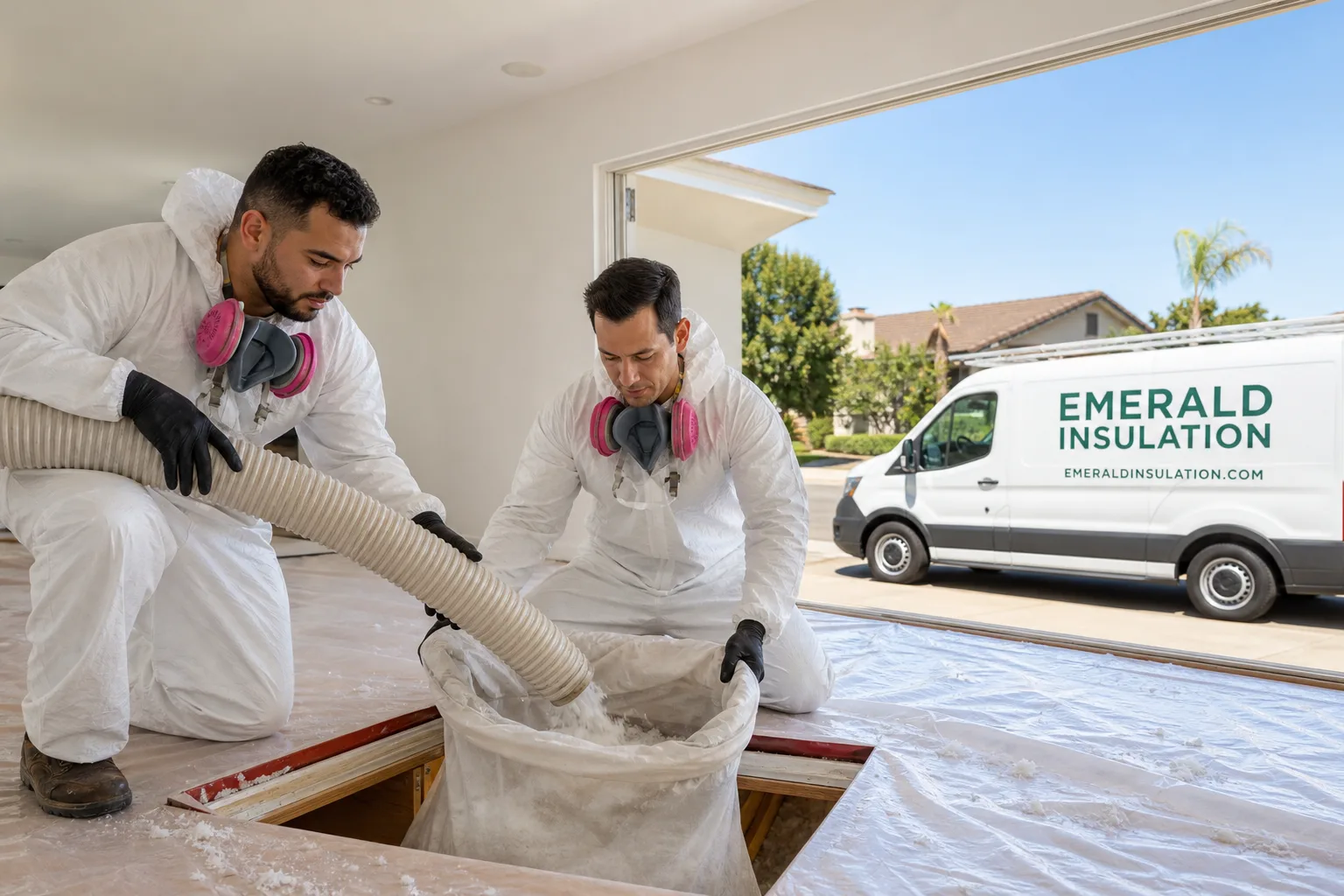
Fast, Reliable Spray Foam Insulation Across Fountain Valley
Spray foam insulation in Fountain Valley solves a specific problem: heat that builds up in low-pitch ranch attics and radiates into living spaces all afternoon. Most of the homes in 92708 and 92728 went up between the late 1950s and the 1970s, which means original fiberglass batts have been sagging, compressing, and underperforming for decades. The fix is almost always a retrofit decision, not a new-construction one. Our team at Emerald Insulation knows these attics because we’ve crawled through hundreds of them across Fountain Valley, from the Magnolia corridor to the tracts near Mile Square Park. Call (855) 490-8655 and we’ll walk you through what your roof deck actually needs.
Why Emerald Insulation Is Fountain Valley’s Preferred Spray Foam Insulation Company
Fountain Valley homeowners call us because we treat their house as a retrofit project, not a blank slate. A 1962 stucco ranch on a slab foundation has different needs than a 1990s two-story, and we’ve spent enough hours in these attics to know exactly what that means before we ever open a can of foam. Our crews work throughout Fountain Valley weekly, so scheduling is straightforward and we’re typically on-site within a day or two of your call.
Noel Cartagena leads our team, and his approach is simple: match the material to the job, and explain the reasoning so the homeowner can make an informed decision. That’s why we carry both Icynene and Demilec spray foam systems rather than pushing one product line. Some Fountain Valley attics call for open-cell foam on the roof deck. Others need closed-cell for a garage ceiling or specific moisture conditions. We stock both, and we’ll tell you which one your house actually needs, plus why.
Crawl Space Spray Foam Insulation in Fountain Valley
Crawl Space Spray Foam Insulation in Fountain Valley is less common than attic work because most of this city’s homes sit on slab foundations. But additions and a handful of older builds do have crawl spaces, and when they do, the problems are consistent: exposed floor joists, moisture creeping up from the soil, and outside air leaking through vented foundation walls. Sealing that space with spray foam cuts the stack effect that pulls hot, damp air up into the house all summer.
For a typical Fountain Valley crawl space, expect to pay between $2,800 and $5,400 depending on square footage and access. Tight access under a low addition complicates the job and adds labor, which is why we quote after an on-site look, not over the phone.
Sealing Rim Joists and Sill Plates
The rim joist is where the floor framing meets the foundation, and in older Fountain Valley additions it’s rarely sealed. Spray foam applied to the rim joist and sill plate stops the worst of the air leakage. We apply closed-cell foam here because it adds structural rigidity along with an air seal, which matters in a city where additions were sometimes framed decades after the original build, with joints that have since opened up.
Moisture Control Before Foam
Fountain Valley sits about four miles inland, and the marine layer that rolls in overnight leaves crawl spaces damp for hours each morning. If we find standing water or evidence of pooling after rain, that gets addressed before any foam goes down. Encapsulating over moisture traps it against the framing, and no product on the market survives that kind of neglect for long.
Garage Spray Foam Insulation in Fountain Valley
Garage Spray Foam Insulation in Fountain Valley is one of the most practical upgrades we do, especially on the attached garages so common to 1950s and 1960s ranches here. Those garages share a wall and often a ceiling with the house, but the original builders treated them like outdoor space. No insulation above the drywall, usually none in the walls. That turns the garage into a heat collector every afternoon, and the bedroom above it never cools off.
A typical attached garage in Fountain Valley runs $1,900 to $3,800 for spray foam treatment, depending on whether we’re doing the ceiling only, the shared wall, or the full perimeter. Ceiling-only jobs land at the lower end. Full perimeter sealing with closed-cell foam on the exterior walls costs more but turns an unconditioned garage into a usable workshop space without making it part of the HVAC envelope.
Sealing Around the Garage Door Opening
The opening itself is always a weak point, no matter how good the insulation is behind it. We focus the foam application on the header and the top of the wall plate where the door track mounts. This is also where we find wall cavities that were never insulated when the door was replaced decades later.
Sound and Fume Separation from the House
Many Fountain Valley homeowners use their garages as workshops, gyms, or hobby space. Closed-cell foam on the shared wall and ceiling does double duty here: it blocks heat transfer and noticeably reduces sound and fume migration into the living areas. That’s a material property of closed-cell foam, not an aftermarket add-on, and it’s one of the reasons we reach for Demilec or Icynene closed-cell products on garage ceilings so often.
Our Spray Foam Insulation Process
Every Fountain Valley job starts with an attic inspection, because nothing else matters until we see what’s already up there. Our Spray Foam Insulation team documents the existing batt condition, measures clearance at the low points, finds every ceiling penetration from re-roofs and HVAC swaps, and checks ventilation paths before recommending anything. You get a written quote with the foam type specified and the prep work itemized.
Trusted Brands We Service in Fountain Valley
We carry Icynene and Demilec spray foam because both manufacturers have decades of documented performance in coastal Southern California climates. For Fountain Valley homeowners who want to know why we picked those two, the answer is R-value retention and moisture performance in low-clearance, sun-loaded attics. When the job calls for batts or blown-in rather than spray foam, we also stock Owens Corning, CertainTeed, Johns Manville, Knauf, Rockwool, and GreenFiber. If spray foam isn’t the right material for your particular house, we’ll say so and point you to the product that is. That’s the whole reason we carry eight brands instead of one.
Common Spray Foam Insulation Problems We See in Fountain Valley Homes
- Original 1960s batts sagging over the ceilings. Decades of heat cycling compress fiberglass until it sits at half its original thickness. Spraying foam over these batts without clearing them first seals in the failure and traps moisture against the drywall.
- Ceiling penetrations from re-roofs and HVAC swaps. Almost every Fountain Valley ranch has been re-roofed at least once, and the roofers punched new ventilation holes or left old ones open. Air leaks straight past the insulation through these chases unless every one is identified and sealed before foam application.
- Low-pitch roofs with minimal crawl clearance. The ranch-style roofs here don’t give you much room to work. That changes how foam gets applied and where we can spray effectively without leaving unsealed gaps in the corners.
- Wall assemblies left untouched. Slab-foundation stucco ranches have no crawl space, and the exterior walls were rarely insulated at all. Foam in the attic or garage helps, but the wall cavity remains the weak link – which is why we’re honest about what foam will and won’t fix in a given house.
Pricing for Spray Foam Insulation in Fountain Valley, CA
Spray foam in Fountain Valley runs higher than national averages because this is retrofit work inside existing, occupied homes, not open framing. Here are the ranges we actually see on jobs here:
- Attic roof deck spray foam (open-cell, 1,200-1,800 sq ft): $4,200-$7,800
- Garage ceiling spray foam, attached 2-car: $1,900-$3,400
- Crawl space encapsulation and rim joist sealing: $2,800-$5,400
- Clearing and disposal of old batts before spraying: $900-$2,200 depending on depth and access
Prep work drives a lot of the cost difference between quotes. A clean attic with full standing room costs less than a low-pitch 1963 ranch where old batts have to be bagged and removed before any foam leaves the gun. We quote both the prep and the spray as separate line items so you know exactly what you’re paying for. Estimates in Fountain Valley are free – call (855) 490-8655 and we’ll schedule a walkthrough.
We Also Serve Cities Near Fountain Valley
Our service area covers Fountain Valley and the surrounding communities, including Midway City, Huntington Beach, Costa Mesa, and Westminster. If you’re looking for Spray Foam Insulation in Fountain Valley, you’re in our core territory. We’re based out of Irvine and our crews run routes through Fountain Valley multiple times a week, which keeps scheduling flexible.
Serving Fountain Valley, CA — Our Local Coverage Area
We’re based in the Fountain Valley area and know this community well. Use the map below to see our service coverage — if you’re nearby, we can almost certainly help.
FAQs About Spray Foam Insulation in Fountain Valley
Because the original 1960s fiberglass batts in these attics have collapsed, compressed, and absorbed decades of dust and roofing debris. Foam sprayed directly over the top traps moisture against the drywall and never achieves the air seal it’s supposed to deliver. We clear, bag, and remove the old material so the foam bonds directly to the roof deck or drywall. Call (855) 490-8655 and we’ll inspect your attic before you commit to anything.
Yes, and it’s often the best option for a low-pitch Fountain Valley attic. The alternative – piling more fiberglass into a space too tight to crawl through properly – rarely solves the air-sealing problem that’s actually driving your heat gain. Closed-cell foam applied to the underside of the roof deck seals the entire assembly without eating up what little standing room exists. The tradeoff is that this is a more expensive install than blown-in, and we’ll give you a straight cost comparison before you decide.
Replace it, in almost every case where the original material is still present. You can’t repair fiberglass that has compressed to half its designed thickness – the structure of the material is gone. The decision is really about what to replace it with, and in Fountain Valley’s low-clearance ranch attics, spray foam on the roof deck usually delivers more comfort per dollar than re-batting the ceiling alone. It’s a bigger upfront cost and a much bigger difference in how the house feels at 4 p.m. on a summer afternoon.
Garages almost always benefit from spray foam if they’re attached to the house, because the shared wall and ceiling act as a thermal bridge directly into your living space. Crawl spaces under additions benefit too, though most Fountain Valley homes sit on slabs and don’t have one. Where both exist, sealing them changes how the whole house holds temperature – not just one room.
No. The marine layer cools your mornings, but the real issue here is sun-driven attic heat gain from unvented, under-insulated roofs, which builds all afternoon whether or not fog rolled in at 7 a.m. Spray foam addresses that heat at the source – the roof deck – rather than just slowing it on the way into your living room.
Written by Noel Cartagena, Owner at Emerald Insulation, serving Fountain Valley and surrounding Orange County communities.