
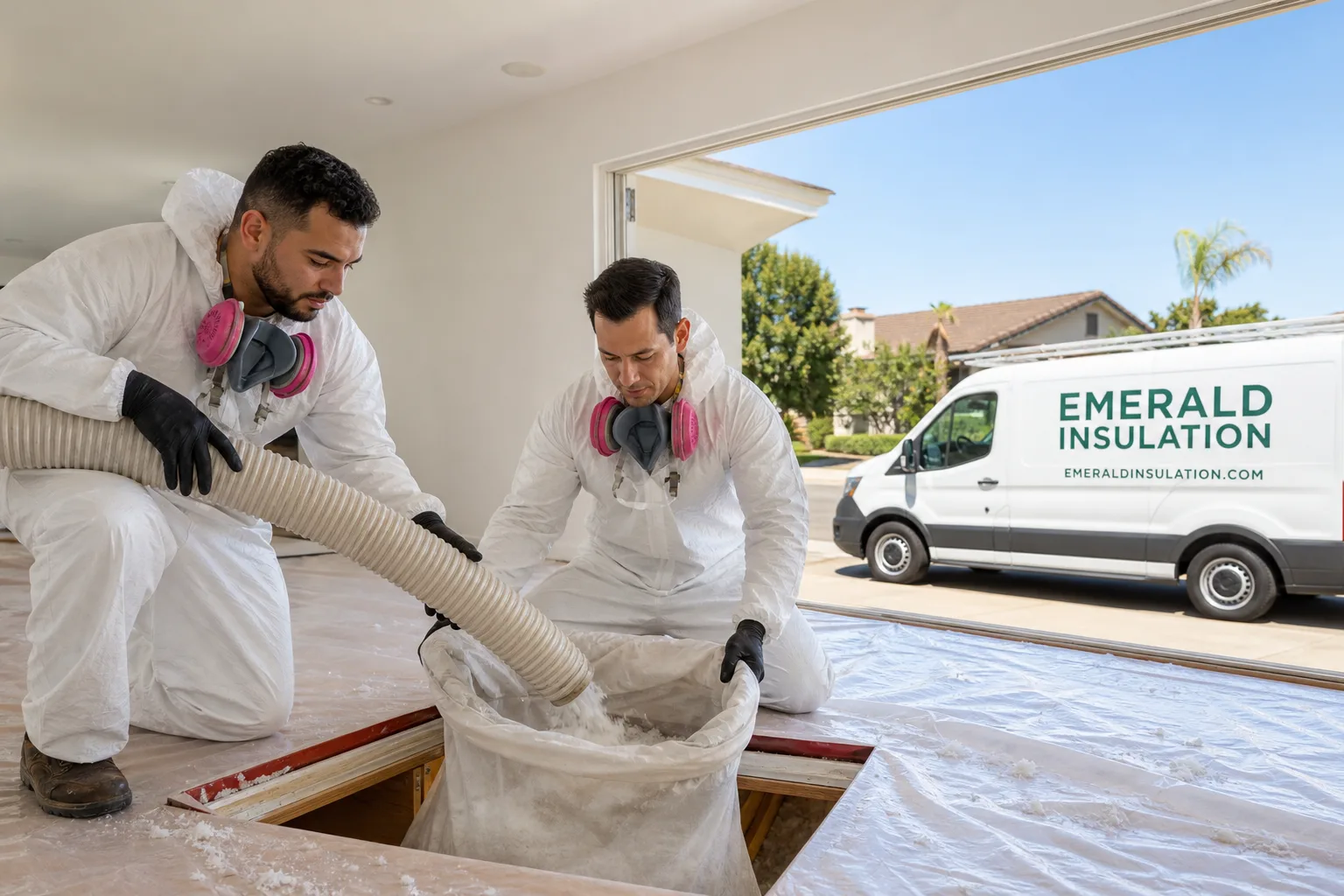
Fast, Reliable Spray Foam Insulation Across Cypress
Spray foam insulation in Cypress does two jobs that matter here more than most places: it seals the gaps in 1950s and 60s tract home construction, and it handles the temperature swings between warm inland summers and damp marine-layer mornings. Most Cypress homes we inspect have original fiberglass that settled years ago, leaving wall cavities and rim joists exposed. That’s why we run crews into Cypress weekly, usually within a day or two of your call. Noel Cartagena built Emerald Insulation around matching the right foam system to the house, not pushing one product. Call us at (855) 490-8655 and we’ll tell you what your attic or crawl space actually needs after we look at it.
Key Takeaways:
- Cypress’s 1950s-60s tract homes almost always have settled or missing insulation, especially near the older cul-de-sacs along the Los Alamitos border.
- Closed-cell spray foam addresses both heat gain in summer and moisture intrusion in winter, which fits Cypress’s coastal-influenced climate.
- We carry Icynene and Demilec spray foam systems, and we match the product to your house, not the other way around.
- Free estimates, same-week service in 90630, and a crew that knows Cypress housing stock from the slab up.
Why Emerald Insulation Is Cypress’s Preferred Spray Foam Insulation Company
We’re based in Irvine, but a good portion of our week is spent in Cypress. That matters because Cypress homes have a specific set of problems that newer subdivisions just don’t have: original wood-frame construction from the Eisenhower and Kennedy years, attics with compressed batts that have lost most of their R-value, and garage door openings that were framed for one-piece doors that don’t seal anywhere close to modern standards. Homeowners call us after a summer AC bill hits $400 and they want to know why the upstairs won’t cool.
Our crews know the difference between a Cypress ranch with a vented attic and a newer infill townhome near the 91 freeway. We’ve worked along Katella, Ball Road, and the streets south of Cerritos, and we know which houses on which blocks are likely to have settled insulation behind the original drywall. That local pattern recognition means we don’t waste your time with a one-size-fits-all proposal. We bring both open-cell and closed-cell options, explain what each does in a Cypress attic or crawl space, and give you a straight answer. Noel reviews every bid personally before it goes out.
Response time to Cypress is typically next-day for estimates, and scheduling is usually inside a week. We keep our calendar open for 90630 because we know summer heat doesn’t wait. Call (855) 490-8655 and you’ll talk to a person who knows the difference between a 1962 ranch on a slab and a 1978 two-story with a raised foundation.
Crawl Space Spray Foam Insulation in Cypress
Crawl Space Spray Foam Insulation in Cypress homes matters because a lot of the original construction here sits on raised foundations, and the crawl space is where the house leaks conditioned air all year. In a 1960s Cypress ranch, the rim joist is usually uninsulated, which means the edge of your floor is basically open to whatever the outside air is doing. We spray closed-cell foam directly onto the rim joists and band boards, sealing the perimeter. A typical Cypress crawl space runs $2,400 to $5,600 for full rim joist encapsulation, depending on square footage and access. Homes with tight crawl spaces under 18 inches of clearance push toward the higher end because the work is slower.
The moisture question is real here. Cypress gets that marine layer in the mornings, and a crawl space that’s sealed wrong can trap that damp air against the floor framing. That’s why we favor closed-cell foam for Cypress crawl spaces. It acts as a vapor barrier and air seal in one pass, and it doesn’t absorb water the way fiberglass does when it gets damp. If you’re feeling cold floors in winter, the crawl space is often the culprit.
Crawl Space Encapsulation Systems
We don’t just spray the rim joists and leave. A proper crawl space treatment in Cypress means sealing the foundation vents, laying a heavy vapor barrier over the dirt floor, and then foaming all the transition points where the house meets the foundation. This is the only way to stop both air movement and ground moisture at the same time. Homes near the Los Alamitos border, where the soil tends to hold more moisture after rain, benefit most from the full system rather than a rim joist-only spray.
When to Retrofit a Vented Crawl Space
Most Cypress homes built before 1970 have vented crawl spaces, which was standard practice then but is wrong for our climate. If you smell must in the hallways or the floor feels cold in January, your crawl space is pulling damp air up into the house. Spray foaming and closing those vents changes the whole pressure dynamic. We’ll tell you honestly if your crawl space is a good candidate, because sometimes it’s better to leave vents open and just air-seal the floor cavity. That recommendation depends on drainage, soil type, and whether you have any history of standing water.
Garage Spray Foam Insulation in Cypress
Garage Spray Foam Insulation in Cypress does more than people expect, especially on those original one-piece garage doors and early sectional doors from the 60s and 70s. The garage is usually the single biggest air leak in a Cypress home because the door never seals well and the garage ceiling is often completely uninsulated. We spray the garage ceiling with closed-cell foam, then address the rim joists where the garage meets the house. A standard two-car garage ceiling in Cypress runs $1,800 to $3,400 for closed-cell foam to R-21 or better. Adding rim joist work brings the total to $2,500 to $4,800.
We spray the garage ceiling rather than batts because batts sag, and in a hot Cypress attic that heat pours straight down into the garage. Closed-cell foam adheres directly to the drywall or roof deck and won’t settle or pull away. If your garage shares a wall with the house, like most Cypress ranches, foam on that shared wall helps keep the living room from heating up every afternoon. If the garage is below a bonus room, this is often the difference between a room you can use in August and one you can’t.
Garage Ceiling and Band Board Sealing
We back the garage ceiling spray with air sealing along the band board where the garage framing meets the foundation. In Cypress, unsealed band boards let hot air in during summer and cold air in during winter, and they’re a hidden source of the garage smelling like whatever’s outside. Foam at the band board also keeps exhaust fumes from a running car out of the house, which is a real concern when the shared wall isn’t sealed.
Garage Conversion Prep
If you’re planning to convert a Cypress garage into a room or workshop, spray foam is the first step. The city is strict about conversions, and the insulation is what makes the space actually livable. We’ll coordinate with your contractor so the foam is in before the drywall goes up. Closed-cell on the walls and ceiling of a converted garage also handles the temperature swings better than fiberglass, which matters when the old garage door comes out and the wall goes in.
Trusted Brands We Service in Cypress
We’re certified installers for both Icynene and Demilec spray foam systems, and we stock both open-cell and closed-cell product for Cypress work. We carry Demilec for closed-cell applications where R-value per inch and moisture resistance are the priority, and Icynene for open-cell jobs where you need a softer, more flexible fill in wall cavities. We also work with Owens Corning and Rockwool for jobs where a hybrid approach makes sense, like a Cypress attic where foam on the roofline pairs with mineral wool in the walls. Because we stock multiple brands, we’re not married to any one of them. The house tells us what it needs, and we match the material to the job. That’s the whole point of Spray Foam Insulation done right.
Common Spray Foam Insulation Problems We See in Cypress Homes
- Settled attic batts buried under blown-in fiberglass. In 1950s-60s Cypress tract homes, we often find original batts compressed to half their depth under a layer of old blown-in fiberglass. The homeowner thinks the attic is insulated, but the effective R-value is far below what it should be, and the top plates around the perimeter are completely exposed.
- Unsealed rim joists on raised foundations. Cypress homes on raised foundations leak conditioned air at the rim joist, where the floor framing meets the foundation wall. We see this on nearly every pre-1975 home we inspect, and it’s why floors feel cold even when the thermostat says the heat is on.
- Garage ceiling with zero insulation above a bonus room. So many Cypress ranches have finished bonus rooms over the garage, and the garage ceiling below is bare drywall. A bare garage ceiling in August is an oven, and the bonus room above it never cools down. This is one of the highest-ROI spray foam applications we do in 90630.
- Failing original garage door openers creating gaps. Original 1960s chain-drive openers with worn gears and failing capacitors reverse randomly or stop partway, leaving the garage door open an inch or two. That gap lets conditioned air pour out and undermines whatever insulation you have. We see this all the time in Cypress, and it’s often the first thing we point out before any foam goes in.
Pricing for Spray Foam Insulation in Cypress, CA
You’ll pay based on square footage, foam type, and access, but here are real Cypress numbers. An attic rim joist and top plate seal runs $1,200 to $3,000. A full garage ceiling in closed-cell foam runs $1,800 to $3,400. A crawl space rim joist encapsulation with vapor barrier runs $2,400 to $5,600. A whole-home retrofit combining attic, garage, and crawl space typically lands between $6,000 and $14,000, depending on the size of the house. Open-cell foam runs about $0.45 to $0.75 per board foot in Cypress, and closed-cell runs $0.90 to $1.40. We give you a written quote before any work starts, so you’ll know the exact number. Estimates are free. Call (855) 490-8655 to schedule one.
We Also Serve Cities Near Cypress
We’re in Cypress every week, and we also cover the surrounding communities: La Palma, Los Alamitos, Rossmoor, and Hawaiian Gardens. The housing stock across these areas is remarkably similar, lots of 1950s-70s tract homes with the same settled insulation and leaky garage door patterns. We know these neighborhoods well, and our schedule usually lets us see a new customer within two days anywhere in this part of Orange County.
Serving Cypress, CA — Our Local Coverage Area
We’re based in the Cypress area and know this community well. Use the map below to see our service coverage — if you’re nearby, we can almost certainly help.
FAQs About Spray Foam Insulation in Cypress
Spray foam can help the garage ceiling and rim joists, but it won’t fix the door itself. A one-piece garage door from the 1960s with a worn seal and old torsion springs will never close tight, and that gap lets air pour around whatever insulation you install. We recommend addressing the door seal and springs first, then foaming the ceiling and walls. We’ll tell you exactly what’s worth doing before you spend anything. Call (855) 490-8655 and we’ll inspect the whole garage together.
If you can see the top plates of your wall framing above the insulation, it’s settled. In Cypress, we commonly find 1960s-era fiberglass batts compressed to about 3 inches where they should be 9 or 10, especially along the older cul-de-sacs near the Los Alamitos border. You might also notice rooms that never cool evenly, or an attic that’s hot enough to bake bread in summer. The simplest test is to look at the joists: if they’re visible, the insulation has settled and you’re losing heat or cooling through the frame. We’ll confirm what’s there and what you need with a free attic inspection.
Closed-cell foam is the right choice for a Cypress garage. It has a higher R-value per inch, which matters when the attic above is 130 degrees, and it acts as a vapor barrier, which matters when the marine layer sets in and the air gets damp. We use Demilec closed-cell for most Cypress garage ceilings because it handles both extremes without trapping moisture. If you’re on a tighter budget, open-cell on the garage ceiling will still cut heat gain, but it won’t provide the same moisture resistance. We’ll give you both options and explain the trade-off before you decide.
Yes, if it’s sprayed by someone who doesn’t understand how a vented crawl space works in inland Orange County. Cypress gets genuine dampness from the marine layer, and sealing a crawl space incorrectly can trap that humid air against the framing. That’s why we use closed-cell foam, which doubles as a vapor barrier, and we always pair it with proper floor encapsulation and drain inspection. The key is closing the vents, laying a full vapor barrier on the dirt, and foaming the rim joists so no outside air can get in. Done that way, the crawl space becomes dry and stable. Done halfway, it becomes a mold risk. We won’t spray a crawl space unless we’d do it the same way in our own house.
Cypress follows California Building Code Title 24 for insulation, which sets minimum R-values and requires a thermal barrier between spray foam and living space, usually 1/2-inch drywall. The city also requires permits for garage conversions involving insulation, but re-insulating an existing attic or crawl space typically doesn’t need a permit. If you’re converting a garage or adding a room, we’ll coordinate with your contractor to make sure the foam spec meets Cypress code before any inspector sets foot on the property. Noel can tell you what your specific project will need when you call (855) 490-8655.
Ready to solve the real insulation problems in your Cypress home? We’ll come out, look at what you’ve got, and tell you the truth. Free estimate, no pressure. Call Emerald Insulation at (855) 490-8655. Ask for Noel, and he’ll make sure the person who shows up knows Cypress construction inside and out.
Written by Noel Cartagena, Owner at Emerald Insulation, serving Cypress and surrounding Orange County communities.