Fast, Reliable Attic Insulation Across Fountain Valley
Attic insulation in Fountain Valley is, for most homes here, a retrofit job on a low-clearance 1960s ranch roof rather than a simple blow-in. The original fiberglass batts in these attics have usually sagged, compressed, or been shoved around by decades of re-roofing and HVAC work, so the first step is almost always clearing and re-leveling before any new material goes down. We know Fountain Valley’s housing stock because we work on it every week, from the 92708 tract homes south of Talbert to the newer pockets in 92728. If your energy bills climb every July and your ceiling feels warm by 3 p.m., call us at (855) 490-8655 for a free estimate.
Why Emerald Insulation Is Fountain Valley’s Preferred Attic Insulation Company
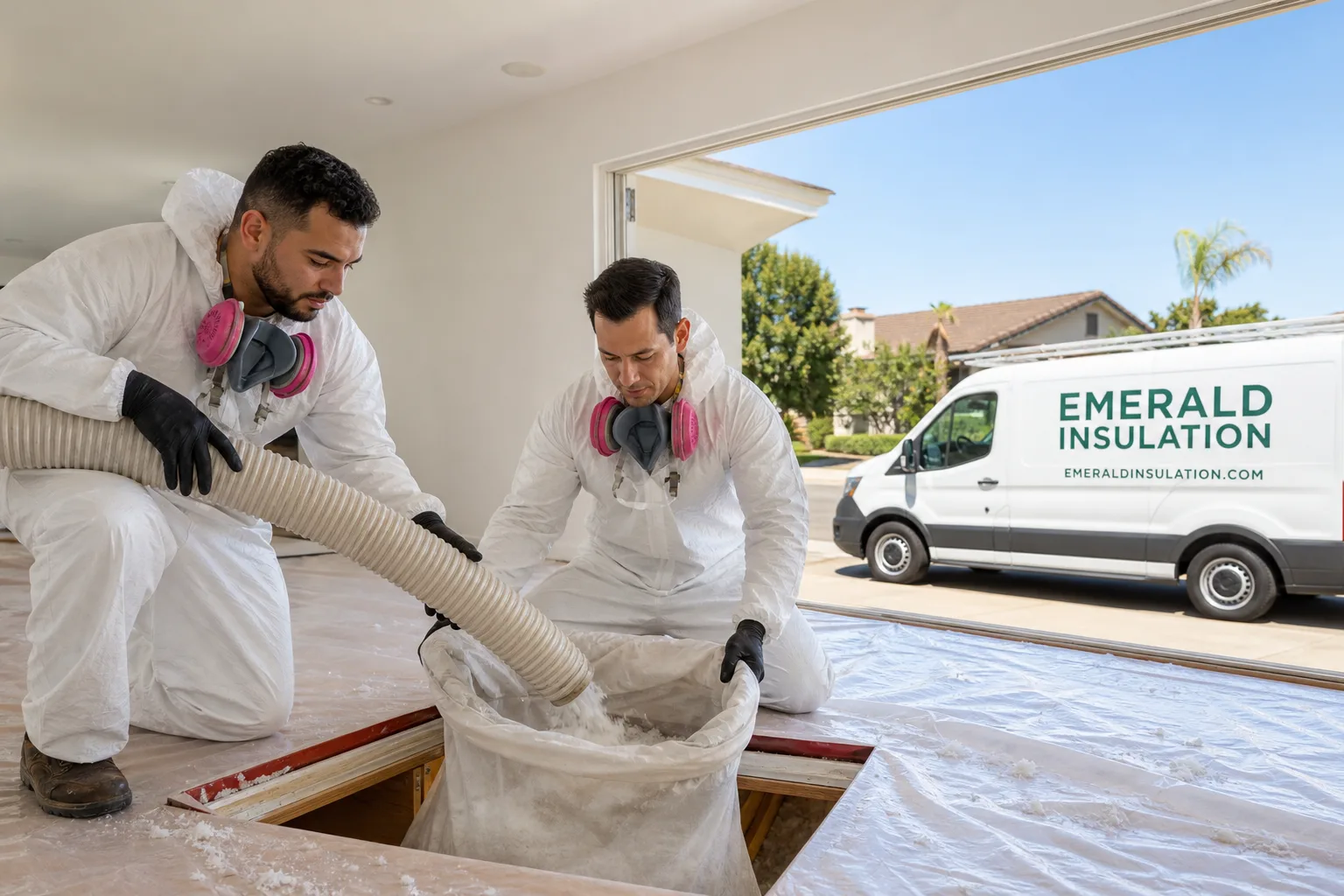
Fountain Valley homeowners tend to do their homework before hiring a contractor. We respect that. What they find with Emerald Insulation is a team that stocks eight insulation brands and matches the material to the home’s actual conditions, not to whatever a single supplier happens to push that month. On a 1968 single-story ranch off Slater Avenue in 92708, our crew found the builder-grade attic access panel buried under sagging original batts that had been pushed aside during an HVAC swap, leaving a bare strip of ceiling with nothing over it. We cleared and re-leveled the old fiberglass, sealed the penetrations, and reinstalled the panel with new weatherstripping before blowing in Owens Corning fiberglass to a consistent depth across the low-clearance bays. Because the same builder-era shortcuts extended to the garage, we also flagged the sagging weather seal and out-of-balance door as the next upgrade for the homeowner.
That level of detail is standard for us here. Fountain Valley is almost fully built out, so every attic we enter has decades of history in it. Response time to Fountain Valley is typically same-week, often next-day. Led by Noel Cartagena, our crew treats your attic as a diagnostic site, not a place to dump material and leave.
Attic Ventilation in Fountain Valley
Attic Ventilation in Fountain Valley is about managing the marine layer and the afternoon sun. The city sits roughly four miles inland, so mornings are cool and damp while summer afternoons bake the roof deck. Without balanced intake and exhaust airflow, that heat sits in the attic and radiates down into the house all evening, which is exactly what drives up AC demand in July and August.
Matching Ventilation to Low-Pitch Roofs
Most Fountain Valley ranches have shallow roof cavities, so standard ridge vents and soffit vents need to be sized carefully. We often add baffles before blowing new insulation to keep airflow channels open to the outside. Without them, even a fresh insulation layer can block air movement and leave the attic hotter than before.
Clearing Blocked Vent Paths Before Insulating
Decades of re-roofing and HVAC work have left many Fountain Valley attics with vents that are buried, painted over, or crushed. Our standard practice is to inspect and clear every vent path before we install anything new. Insulation over a dead vent is wasted money.
Radiant Barrier in Fountain Valley
Radiant Barrier in Fountain Valley makes particular sense given how much of the cooling load here is sun-driven rather than ambient heat. A radiant barrier stapled to the underside of a low-pitch 1960s roof deck reflects a large share of radiant heat before it can soak into the attic air, which pairs well with re-leveled insulation and properly cleared ventilation.
Where Radiant Barrier Works Best on Ranch Homes
On low-pitch roofs with minimal attic clearance, radiant barrier is one of the most practical upgrades because it doesn’t require additional depth. The material installs directly against the roof deck and works independently of how much insulation lies on the ceiling plane. For Fountain Valley ranches with limited headroom, that’s a key advantage.
Pairing Radiant Barrier with an Insulation Retrofit
We usually recommend radiant barrier as part of a combined attic upgrade: clear old batts, seal penetrations, install baffles, add radiant barrier to the roof deck, then blow new insulation over the ceiling. Alone, each step helps. Together, they cut the attic-to-living heat transfer substantially, which is the real goal for Fountain Valley summers.
Trusted Brands We Service in Fountain Valley
We carry GreenFiber, Owens Corning, and Johns Manville because each solves a different problem in Fountain Valley attics. GreenFiber cellulose is useful in low-clearance retrofit situations where a dense, fire-resistant fill makes sense. Owens Corning fiberglass is our go-to for consistent coverage and lot-to-lot verification. Johns Manville offers options for homeowners who want specific R-value targets without overbuilding. Because we stock multiple brands, we can match the material to your home rather than steering you to whatever’s on the warehouse shelf. That’s the entire reason Emerald exists as a multi-brand insulation specialist.
Common Attic Insulation Problems We See in Fountain Valley Homes
- Sagging 1960s batts with bare ceiling strips. Original fiberglass batts in homes along Euclid, Bushard, and Slater have compressed under decades of re-roofing and HVAC swaps, leaving ceiling areas with little or no insulation that go unnoticed until a heat wave.
- Low-pitch roofs that invite uneven blow-ins. Shallow attics need careful leveling and baffle work before new material goes in. A rushed installburying vents and covering the access panel makes the whole job perform worse, not better.
- Leaky attic access panels. Builder-grade panels on 1950s-1970s tract homes were rarely weatherstripped or insulated. Air leakage at the panel undermines everything else, and marine-layer moisture finds its way in through the gap.
- Disturbed insulation after room additions. Fountain Valley has a lot of homes with added bedrooms or extended living areas. The original attic insulation was often pushed aside during construction and never put back, leaving a patchwork under the roof.
Pricing for Attic Insulation in Fountain Valley, CA
A basic attic insulation top-up in a typical Fountain Valley three-bedroom ranch runs $900-$1,500. Full attic insulation replacement, including clearing old batts, air sealing penetrations, and blowing in new material, typically lands between $1,800 and $3,400 depending on square footage and attic accessibility. Radiant barrier installation adds roughly $1.50-$2.50 per square foot of roof deck. Attic ventilation correction, including baffle installation and clearing blocked vents, ranges from $400-$1,100. Low-clearance 1960s roofs with difficult access push costs to the higher end of these ranges. Call (855) 490-8655 for a free estimate on your specific house, no pressure and no guessing.
We Also Serve Cities Near Fountain Valley
Emerald Insulation handles Attic Insulation projects throughout the surrounding Orange County area. Beyond Fountain Valley, we regularly work in Midway City, Huntington Beach, Costa Mesa, and Westminster, where the housing stock and retrofit challenges are much the same: aging tract ranches, low-pitch roofs, and energy bills that don’t match the square footage.
Serving Fountain Valley, CA — Our Local Coverage Area
We’re based in the Fountain Valley area and know this community well. Use the map below to see our service coverage — if you’re nearby, we can almost certainly help.
FAQs About Attic Insulation in Fountain Valley
We don’t recommend it. The original batts in most 1960s Fountain Valley attics are compressed, sagging, or pushed aside from HVAC and re-roofing work. Blowing new insulation directly over disturbed old batts buries vents, covers the access panel, and leaves the same bare ceiling strips under the new material. The right approach is clearing and re-leveling first, then sealing penetrations, then blowing new insulation to a consistent depth. Call (855) 490-8655 and we’ll inspect your attic and tell you honestly whether yours is a top-up situation or a full clear-and-replace.
The west-facing rooms in 92708 homes take direct afternoon sun, and the attic above them heats up the most. When original 1960s batts have sagged or been shoved aside near the eaves, those rooms lose their thermal barrier exactly where the roof deck is hottest. Poor ventilation compounds it. The fix is often a combination of re-leveling the attic insulation, clearing vent paths, and adding radiant barrier to the underside of the roof deck over those rooms. We can pinpoint the problem with an attic inspection.
Not harder, but it does require more care. Low-pitch roofs mean less attic clearance, so our crew works in tighter spaces and installs radiant barrier with staples and careful seam overlap rather than rushed full-sheet runs. The material itself goes up against the roof deck, so ceiling height is not the limiting factor. The real issue is access, and we’re used to working in shallow Fountain Valley attics.
Many Fountain Valley tract homes still have builder-grade garage doors and openers from the original construction, and those are the same era of cost-cutting that left the attics under-insulated. While we’re in the attic, our crew checks the garage ceiling for insulation gaps and air leaks, and we’ll flag a sagging weather seal or unbalanced door if we see one. It’s a separate upgrade, but a natural one to coordinate while you’re already improving the home’s thermal envelope.
Look at the condition of the existing material, not the thickness. If the batts are flat, dry, and evenly spread, a top-off may be enough. If they’re compressed, sagging, or disturbed by HVAC work or room additions, a full clear-and-re-level is the better investment. The only way to know for sure is an attic inspection. We’ll give you a straight answer and a written estimate, and you can reach us at (855) 490-8655.
Call Emerald Insulation at (855) 490-8655 for a free estimate on attic insulation in Fountain Valley. We serve all of 92708 and 92728, from the neighborhoods off Talbert and Warner to the homes west of the 405.
Written by Noel Cartagena, Owner at Emerald Insulation, serving Fountain Valley and greater Orange County.