
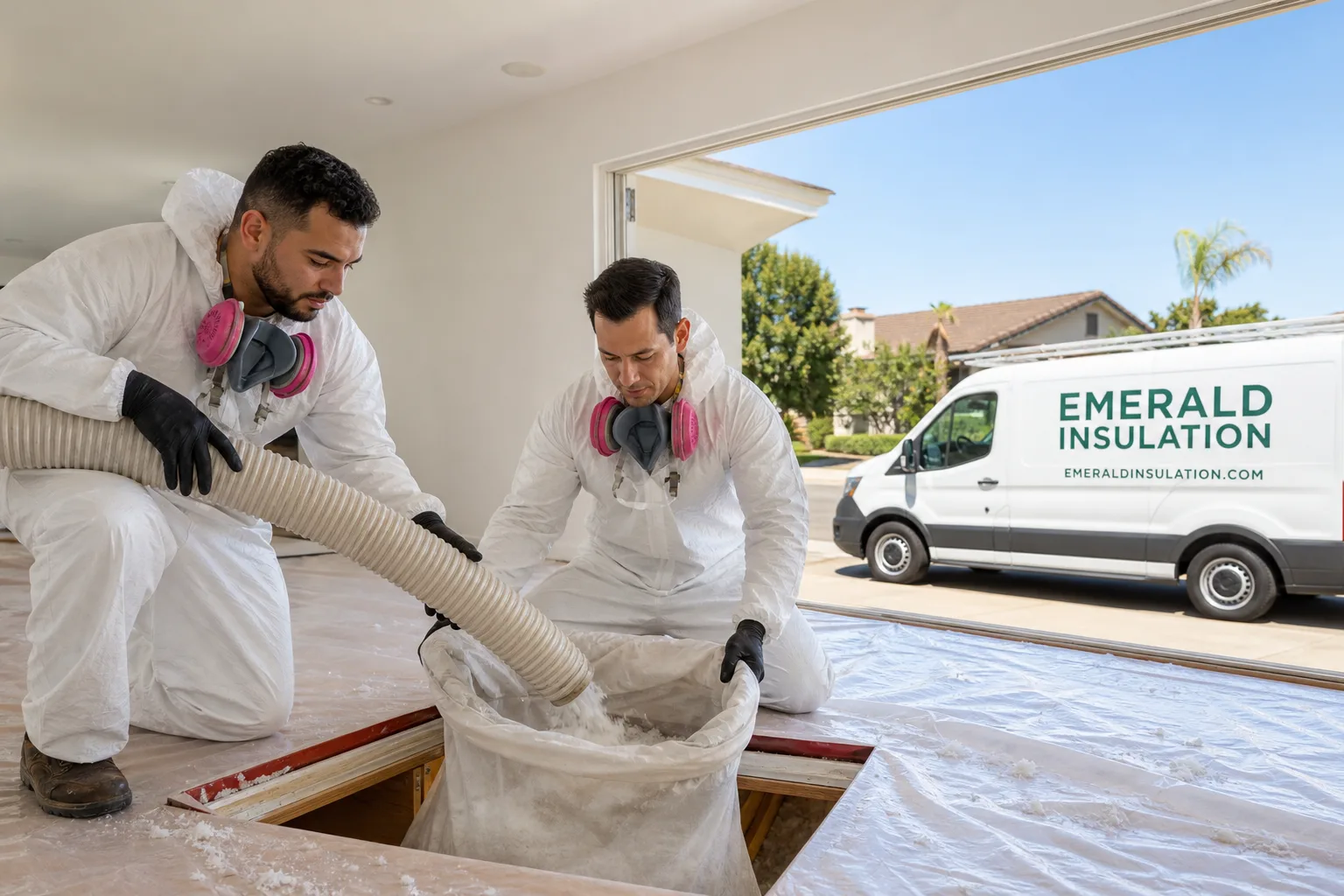
Trusted Spray Foam Insulation for Stanton Homeowners
If you’re wondering how much Spray Foam Insulation costs, Stanton pricing typically runs between $3.00 and $7.50 per square foot installed, with most Stanton homes falling in the $4,500 to $12,000 range depending on application area and foam type. Closed-cell runs higher than open-cell because it delivers roughly double the R-value per inch. We install both, and we’ll tell you honestly which one fits your house, your budget, and what you’re actually trying to fix. If your upstairs bedrooms bake in July or your AC seems to run nonstop from June through October, spray foam is often the highest-impact upgrade you can make. Call (855) 490-8655 and Noel Cartagena or one of our installers will walk you through what makes sense for your home.
Stanton’s climate is the quiet villain here. Summer heat pushes attic temperatures past 140 degrees, and the marine layer keeps mornings damp year-round. That combination punishes poorly sealed homes. Most Stanton houses built before 2000 have fiberglass batts that leave gaps around plumbing, electrical runs, and recessed lights. Nearby homeowners considering Tustin Spray Foam Insulation face the same legacy insulation issues. Spray foam doesn’t just insulate. It air-seals. That’s the difference between slowing heat transfer and actually stopping the air movement that drives most comfort complaints.
As a multi-brand insulation contractor, Emerald Insulation carries both Icynene and Demilec spray foam systems. Why does that matter to you? Because each manufacturer has different open-cell and closed-cell formulations suited to different conditions. We also install Owens Corning, Johns Manville, Knauf, CertainTeed, Rockwool, and GreenFiber products across our attic and blown-in work. We match the material to the job, not the job to whatever happens to be on the truck. You can learn more about the full scope of what we do on our home page.
Closed Cell Spray Foam Insulation
Closed Cell Spray Foam Insulation is a dense, rigid foam that cures to about 2 pounds per cubic foot, delivering an R-value of approximately R-6.5 to R-7 per inch and acting as a vapor barrier at just 1.5 inches of depth. It’s the right choice when you need maximum thermal resistance in limited space, moisture control, or structural reinforcement. In Stanton homes with cathedral ceilings, crawl space encapsulation projects, or exterior wall retrofits, closed-cell is often the best-performing option despite its higher price point. Emerald Insulation installs closed-cell systems from both Icynene and Demilec, and we’ll recommend it when the conditions call for it, not because it has a higher ticket.
Where Closed-Cell Excels
Closed-cell foam shines in areas with moisture exposure or limited cavity depth. A 2×4 wall cavity can achieve R-21 with closed-cell, where open-cell would only reach about R-13. In Stanton, where homes built in the 1950s and 60s often have shallow wall cavities and older sheathing, that performance difference matters.
We also use closed-cell for rim joist sealing and crawl space encapsulation because it forms a continuous air and vapor barrier. Once cured, closed-cell adds structural rigidity to the framing. That’s a real benefit in older Stanton homes where wood framing has softened over decades of humidity cycles.
What Closed-Cell Costs in Stanton
Closed-cell spray foam in Stanton generally runs $1.50 to $3.00 per board foot, which translates to roughly $5.50 to $7.50 per square foot for a typical wall or ceiling application. An attic roof deck encapsulation might land between $9,000 and $16,000 depending on square footage and access difficulty.
It’s more expensive than open-cell, but the moisture-control and structural benefits often eliminate the need for separate vapor barrier work or additional framing reinforcement. Get an accurate number by calling (855) 490-8655 for a site assessment.
Open Cell Spray Foam
Open Cell Spray Foam is a lighter, semi-rigid foam that expands aggressively to fill cavities, delivering about R-3.7 per inch and excellent sound-dampening properties at roughly half the installed cost of closed-cell. It’s the workhorse choice for attic roof decks and interior walls where moisture control isn’t the primary concern and budget efficiency matters. In Stanton, open-cell is our most common recommendation for standard attic insulation upgrades because it air-seals the roofline while keeping the project cost accessible for most homeowners.
Where Open-Cell Makes Sense
Open-cell foam excels in vented and unvented attic applications where you want to bring the HVAC system inside the conditioned envelope. Most Stanton homes have ductwork running through the attic. When that attic hits 140 degrees in August, your AC is working against itself. Open-cell on the roofline brings the attic temperature down dramatically.
It’s also the preferred choice for interior wall insulation and soundproofing between rooms. The open-cell structure absorbs sound better than closed-cell, which is why we use it in home theaters, bedrooms adjacent to living spaces, and bonus rooms over garages.
What Open-Cell Costs in Stanton
Open-cell spray foam in Stanton typically runs $0.45 to $0.90 per board foot, or about $3.00 to $5.50 per square foot installed. A standard 1,200 square foot attic roof deck commonly lands between $4,500 and $8,000.
The lower material cost makes open-cell the right entry point for homeowners who want spray foam performance without the closed-cell premium. We’ll give you both numbers and explain exactly what you’re getting for the difference. Call (855) 490-8655 for a detailed quote.
Spray Foam Insulation Contractors
Spray Foam Insulation Contractors are specialized installers trained and certified to apply expanding foam insulation systems from manufacturers like Icynene and Demilec. Unlike general contractors who sub out insulation work or handymen who pick up a DIY kit from a big-box store, a certified spray foam contractor brings calibrated equipment, manufacturer-specific training, and an understanding of how foam chemistry behaves in different temperature and humidity conditions. Emerald Insulation handles all spray foam work in-house with certified crews, never subcontracting to unknown installers.
What to Look for When Hiring
The most important credential is manufacturer certification. Icynene and Demilec both require installers to complete training and demonstrate proficiency before they can purchase and apply their products. Ask any contractor you’re considering which manufacturers certified them. If they can’t answer, keep looking.
Experience with Stanton’s specific housing stock matters too. Homes here range from 1950s tract houses with minimal insulation to newer developments in the northwest section of the city. A contractor who understands how those different assemblies respond to spray foam will make better recommendations than someone applying a generic playbook.
Why Multi-Brand Access Matters
Emerald Insulation carries both Icynene and Demilec product lines, which means our recommendations are driven by the job requirements rather than a single supplier relationship. If a specific Demilec formulation is better suited to your project, that’s what we quote. If Icynene’s open-cell product is the better value, we quote that instead. Most spray foam contractors only offer one brand because they only have one supplier agreement. We carry Spray Foam Insulation in Stanton expertise across both major manufacturers.
We also stock fiberglass from Owens Corning, Johns Manville, Knauf, and CertainTeed, plus Rockwool mineral wool and GreenFiber cellulose for jobs where spray foam isn’t the right call. If blown-in fiberglass is the better answer for your attic, we’ll tell you that. Being brand-agnostic means we can.
Spray Foam Attic Insulation
Spray Foam Attic Insulation is the application of expanding foam to the attic floor or roofline to create an air-sealed thermal barrier that dramatically reduces heat transfer between your living space and the outdoor environment. In Stanton, attic spray foam is our most requested service because the temperature differential between conditioned interiors and unconditioned attics is extreme during the summer months. We also provide Irvine Spray Foam Insulation for homes facing identical coastal heat challenges. Most Stanton attics are vented, meaning they’re designed to stay close to outdoor temperature. That’s a problem when the ductwork and air handler live up there, which they do in nearly every Stanton home with central air.
Roofline vs. Attic Floor
You have two choices with spray foam attic insulation: seal the roofline (the underside of the roof deck) or seal the attic floor. Roofline application brings the entire attic inside the conditioned envelope. Floor application keeps the attic vented and treats it as outdoor space. In Stanton, where ductwork runs through attics, roofline application is usually the higher-performance choice.
If your HVAC equipment is in the attic, sealing the roofline can reduce your cooling load by 20 to 30 percent in peak summer months. That’s real money off your August utility bill, not a theoretical number. We’ll assess your specific attic configuration before recommending one approach over the other.
Duct Sealing as a Bonus
When we insulate an attic with spray foam, we also inspect and seal accessible duct connections. Leaky ducts in a hot attic are one of the biggest sources of energy waste in Stanton homes. The Department of Energy estimates typical duct leakage at 20 to 30 percent of conditioned air. Sealing those runs while foam is being applied is the most cost-effective time to do it.
Most Stanton homeowners see combined duct sealing and attic insulation payback in three to five years through reduced cooling costs alone, with comfort improvements felt immediately. Call (855) 490-8655 to schedule an attic assessment.
Spray Foam Wall Insulation
Spray Foam Wall Insulation is the injection of expanding foam into existing wall cavities or the application of foam to wall framing during new construction or major remodels. It addresses the most common complaint in Stanton’s older housing stock: drafty rooms and uneven temperatures between rooms on the same floor. Many Stanton homes built in the 1950s through 1980s have little to no wall insulation, or fiberglass batts that have slumped and settled over decades.
Retrofit Wall Applications
For existing walls, closed-cell foam can be injected through small access holes drilled through drywall or from the exterior through stucco or siding. The foam expands to fill the cavity completely, sealing air leaks that fiberglass never could. The access holes are then patched and painted. It’s more involved than attic work, but the comfort difference in older Stanton homes is often dramatic.
We’ve seen rooms that were 8 to 10 degrees warmer than adjacent rooms come within 2 degrees after a wall insulation retrofit. That’s the difference between a bedroom you avoid in summer and one you actually use.
New Construction and Remodel Walls
If you’re doing a major remodel or building an addition in Stanton, wall spray foam is worth specifying before drywall goes up. Open-cell is generally the right choice for interior walls and standard exterior walls. Closed-cell makes sense when you need a vapor barrier or live near a source of moisture, like the storm channel that runs through parts of Stanton.
We work with your framing contractor to schedule spray foam application at the right phase of construction. Getting that sequencing right prevents delays. Call us early in the planning process and we’ll coordinate directly with your builder.
Rim Joist Spray Foam
Rim Joist Spray Foam is the application of closed-cell foam to the rim joist area, the band of wood around the perimeter of your home where the foundation meets the floor framing. This is one of the most overlooked air leakage points in Stanton homes. The rim joist is rarely insulated in houses built before energy codes got serious, which means outdoor air moves freely into your floor system and up through your walls. Closed-cell is the right material here because the rim joist area is prone to moisture and needs a product that acts as both insulation and air barrier.
Why Rim Joist Leaks Matter
In a typical Stanton raised-foundation or crawl-space home, the rim joist can account for 10 to 15 percent of total air leakage. That’s outdoor air entering your home exactly where you don’t want it, bringing humidity and dust with it. Seal the rim joist and you immediately reduce drafts at the floor level, which is why so many Stanton homes have cold floors in winter.
We use closed-cell foam for rim joist applications because it won’t absorb moisture and it creates a permanent air seal. Fiberglass batts stuffed into rim joist cavities are common, but they don’t stop air movement. They just filter it a little.
Rim Joist Project Scope
A rim joist sealing project for a typical 1,500 square foot Stanton home takes one to two days and costs between $1,800 and $3,500 depending on access and the number of penetrations. It’s one of the highest-return air sealing projects you can do.
If your crawl space is accessible and the rim joists are exposed, this is straightforward work. If not, we’ll access them through the crawl space or from the exterior as needed. Pairing rim joist sealing with crawl space encapsulation is a common combination that delivers compounding benefits. Learn more about how we handle this for homes near Spray Foam Insulation in Placentia and surrounding areas.
Crawl Space Spray Foam Insulation
Crawl Space Spray Foam Insulation is the application of closed-cell foam to crawl space walls and rim joists to create a sealed, conditioned crawl space that stops the stack effect from pulling damp, dirty air up through your home. In Stanton, many homes sit on crawl spaces, and most of those crawl spaces have vented foundations. Those vents were code-required decades ago, but in Southern California’s climate they create more problems than they solve. They let in humid marine air during cool months and let in hot dry air during summer.
The Stanton Humidity Challenge
Stanton sits close enough to the coast that the marine layer regularly brings relative humidity above 70 percent. When that humid air enters a cool crawl space, condensation forms on ductwork, floor joists, and the underside of subflooring. That’s how you get musty odors, buckling hardwood floors, and mold growth in the crawl space.
Closed-cell foam on crawl space walls creates a vapor barrier that stops that humidity cycle. Combined with a ground vapor barrier, you get a crawl space that stays dry year-round. For homes near the Spray Foam Insulation in Coto De Caza area with larger lots and extensive crawl spaces, this is a standard upgrade package.
What Encapsulation Involves
A full crawl space encapsulation in Stanton typically costs between $5,500 and $12,000 depending on square footage, access height, and the condition of the existing structure. The work includes foaming the walls, sealing the rim joists, installing or upgrading the ground vapor barrier, and sealing or replacing the foundation vents.
Most homeowners report that rooms above the crawl space feel noticeably warmer in winter and less humid in summer within days of completion. If your floors are cold or your house smells musty when the AC kicks on, call (855) 490-8655 for a crawl space evaluation.
Garage Spray Foam Insulation
Garage Spray Foam Insulation is the application of foam to garage walls, ceiling, and sometimes the garage door area to regulate temperature in what is typically the most unconditioned space in a Stanton home. Garages attached to the house are often the biggest thermal hole in the building envelope. In Stanton, where many homes have attached garages that share wall and ceiling assemblies with living space, an uninsulated garage is essentially a giant heat sink attached to your house all summer.
Shared Wall and Ceiling Issues
If your garage shares a wall with the living room or a ceiling with a bedroom above, you’re losing conditioned air through that shared surface every hour the garage is hotter or colder than the house. Insulating the garage doesn’t just make the garage more comfortable. It reduces the load on your HVAC system for the adjacent living spaces.
Open-cell foam is typically the right choice for garage walls and ceilings because the primary goal is thermal and air barrier performance, not moisture control. We recommend closed-cell only when the garage has a specific moisture issue or when you’re converting it to living space.
Garage Conversions and Workshop Spaces
If you’re converting a garage to a home office, gym, or living suite, spray foam is usually the best insulation choice because it air-seals the garage door openings and any existing vents. You’ll need to address the garage door itself with an insulated door or a retrofit panel kit, but the walls and ceiling are where spray foam earns its keep.
A standard two-car garage in Stanton takes one day to insulate with open-cell foam and costs between $2,000 and $4,500 depending on ceiling height and wall area. For garages converted to occupied space, we coordinate with your permit drawings and inspector requirements. Call (855) 490-8655 to discuss your garage project.
Brands We Service
Emerald Insulation is certified to install Icynene and Demilec spray foam systems, two of the most established names in residential spray foam. Icynene has been manufacturing open-cell foam products since 1986 and their formulations are known for consistent expansion rates and reliable performance in climate zones like Southern California. Demilec, now part of Huntsman Building Solutions, produces both open-cell and closed-cell systems with excellent adhesion in retrofit applications. We carry both because different projects genuinely benefit from different foam chemistries.
Beyond spray foam, we stock Owens Corning and CertainTeed fiberglass for attic and wall applications, Rockwool mineral wool for fire-resistant and soundproofing needs, Johns Manville products for specific code-compliance scenarios, and GreenFiber recycled cellulose for homeowners who prioritize sustainability. Whether you have an existing Icynene installation that needs evaluation or you’re considering the full lineup, we can help you make an informed decision. Most Stanton homeowners don’t need to know the technical differences between these brands. That’s our job.
Signs You Need a Pro Right Now
- Your upstairs stays 8 to 10 degrees hotter than downstairs in summer. This is the classic signature of an under-insulated attic and leaky ductwork. Heat rises, and without an air-sealed attic barrier, that heat saturates your upper floor by mid-afternoon. It won’t get better with a new AC unit. The problem is the building envelope, not the equipment.
- Your energy bills have climbed 30 percent or more over the past five years. Utility rates have gone up, but so has the degradation of whatever insulation your home originally had. Fiberglass loses effectiveness as it settles and as dust accumulates in it. If your usage is up and your comfort is down, the insulation is the likely culprit.
- You feel drafts near baseboards, outlets, or recessed lights. Those are air leaks, and insulation alone won’t fix them. You need air sealing, which is exactly what spray foam does. Drafts mean your conditioned air is leaving the house and outdoor air is replacing it continuously, even when your windows are closed.
- Your attic smells musty or you’ve noticed mold spots on the underside of the roof deck. This is a ventilation and moisture problem, and in Stanton’s marine-influenced climate it’s common. The fix often involves closed-cell foam on the roofline to stop condensation from forming. Ignoring it leads to roof deck rot, which is a much bigger repair bill.
- Rodents or pests have made a home in your attic or crawl space. Open gaps around utility penetrations are entry points for rodents, roaches, and other pests. Sealing those gaps with spray foam eliminates the access. You’ll still need pest remediation first, but the foam prevents the re-entry that makes pest problems recurring.
Our Process, Step by Step
- 1
Site Assessment and Diagnostics. We start with a full walk-through of your attic, crawl space, and living areas. We use thermal imaging cameras to identify insulation gaps and air leaks that aren’t visible to the naked eye. This diagnostic step tells us exactly where the problems are before we recommend any solution. We send the assessment summary before we ever hand you a quote.
- 2
Material Recommendation and Quote. Based on the assessment, we recommend specific materials from our eight-brand lineup. You get a line-item quote showing open-cell vs. closed-cell options where both are viable, plus any related air sealing or vapor barrier work. We explain what each option costs and what you get for the difference.
- 3
Scheduling and Preparation. We schedule your installation and tell you exactly what to do beforehand: clearing attic access, moving vehicles from the garage, covering items in adjacent rooms. Most residential spray foam installations in Stanton are completed in one to two days. We protect floors and surfaces before spraying begins.
- 4
Installation. Our certified crew applies the spray foam using calibrated equipment set to the manufacturer’s specifications. Temperature and humidity are monitored throughout the application. Proper foam curing requires the right conditions, and we don’t cut corners when conditions are marginal. The work area is contained and cleaned daily.
- 5
Post-Installation Inspection and Walkthrough. We inspect the cured foam for proper thickness, coverage, and adhesion. You walk through with our lead installer and see exactly what was done, including before-and-after thermal camera images. We review the warranty terms and answer any questions about maintenance, which for spray foam is essentially none.
How Much Does Spray Foam Insulation Cost in Stanton?
A typical spray foam insulation project in Stanton runs between $4,500 and $12,000, with open-cell attic roof deck applications on the lower end and closed-cell crawl space encapsulation or whole-home projects on the higher end. Here’s what common scenarios cost:
| Project Type | Typical Cost Range in Stanton | Time to Complete |
|---|---|---|
| Open-cell attic roofline (1,200 sq ft) | $4,500 – $7,800 | 1 day |
| Closed-cell attic roofline (1,200 sq ft) | $9,000 – $14,400 | 1-2 days |
| Rim joist sealing (1,500 sq ft home) | $1,800 – $3,500 | 1 day |
| Crawl space encapsulation (full) | $5,500 – $12,000 | 2-3 days |
| Garage walls and ceiling (2-car) | $2,000 – $4,500 | 1 day |
| Wall retrofit (per room) | $1,200 – $3,000 | 1-2 days |
Several factors move the price. Access is the biggest one. Tight attics, low crawl spaces, and finished walls all add labor time. Foam type matters second, with closed-cell running roughly double open-cell per board foot. The condition of existing insulation also matters, since removal of old fiberglass before spraying adds disposal and labor costs. Homes that need extensive air sealing prep work, like caulking around electrical boxes and plumbing penetrations, cost more than homes where the foam can be applied directly.
How to avoid overpaying: get a thermal imaging assessment before you accept a quote. If a contractor quotes spray foam without looking at your attic with a thermal camera, they’re guessing at coverage areas. Ask for open-cell and closed-cell options side by side. If a contractor only offers one foam type, you’re not getting objective advice. And always ask what’s included in the prep work. Some contractors quote low and then add charges for masking, cleanup, or old insulation removal. Our free estimates include a complete scope of work, so call (855) 490-8655 and know exactly what you’re paying for before you sign anything.
Our Service Area Near Stanton
We serve Stanton and the surrounding north Orange County area, including Fullerton, Yorba Linda, Cypress, Buena Park, Los Alamitos, Rossmoor, Brea, La Palma, and Hawaiian Gardens. We also handle larger projects in Placentia and Coto De Caza. Most Stanton appointments are scheduled within two to five business days, and we offer same-week availability for urgent situations like exposed insulation after a leak or pest damage. For service coverage details, see our Spray Foam Insulation in Stanton page or contact us directly.
Serving Stanton, CA — Our Local Coverage Area
We’re based in the Stanton area and know this community well. Use the map below to see our service coverage — if you’re nearby, we can almost certainly help.
Frequently Asked Questions About Spray Foam Insulation in Stanton
Spray foam insulation is a liquid foam that expands on contact to form an air-sealing insulation barrier in attics, walls, floors, and crawl spaces. It comes in two types: open-cell, which is lighter and more affordable, and closed-cell, which is denser and provides a built-in vapor barrier. Unlike fiberglass batts, spray foam fills gaps completely and stops air movement, which is the primary cause of energy loss in most Stanton homes.
Most spray foam insulation projects in Stanton are completed in one to two days. An attic roofline application takes a single day, while a full crawl space encapsulation with rim joist sealing takes two to three days. The foam itself cures within hours, and you can be back in your home the same day the installation finishes.
Spray foam insulation in Stanton costs between $3.00 and $7.50 per square foot installed, with most full projects landing between $4,500 and $12,000. Open-cell applications run lower, closed-cell higher. The best way to get an accurate number is a free site assessment with thermal imaging. Call (855) 490-8655 and we’ll give you a detailed, no-obligation quote.
Yes, Emerald Insulation is certified to install both Icynene and Demilec spray foam products. We carry both open-cell and closed-cell formulations from each manufacturer. If you have an existing spray foam installation from either brand that needs evaluation or repair, we can assess it and recommend the right course of action.
Yes, we keep same-week appointment slots available for urgent situations in Stanton and nearby cities. If you have exposed insulation after a roof leak, pest damage that’s torn out your attic insulation, or a failed spray foam installation from another contractor, call (855) 490-8655 and we’ll prioritize your visit. Most emergency assessments are scheduled within 48 hours.
Yes, both Icynene and Demilec products carry manufacturer warranties that cover material performance. Our installation workmanship is also covered under Emerald Insulation’s own warranty terms. We’ll review exactly what’s covered and for how long before any work begins, in writing. Nothing is left to verbal promises.
Preparation is minimal but important: clear a path to your attic access, move vehicles out of the garage for garage projects, and cover items in rooms adjacent to the work area. We handle floor protection, masking, and cleanup as part of every installation. We’ll give you a simple preparation checklist at scheduling so there are no surprises on install day. Call (855) 490-8655 if you have questions about your specific setup.
Schedule Your Spray Foam Insulation Service in Stanton Today
If high energy bills or uncomfortable rooms are the problem, spray foam insulation is likely part of the solution. Call (855) 490-8655 and ask for Noel Cartagena. He’ll schedule a free on-site assessment with thermal imaging, explain what your home actually needs, and give you honest options from our full eight-brand lineup. No pressure, no obligation, just a clear picture of what’s wrong and what it takes to fix it.
Written by Noel Cartagena, Owner at Emerald Insulation, serving Stanton and the surrounding Orange County communities.