Attic Insulation Pricing Breakdown: What Irvine Homeowners Pay in 2026
Most attic insulation quotes in Irvine range from $1,800 to $5,400 for a 2,000 to 3,500 square foot home in 2026, with the biggest cost drivers being material type, existing insulation removal, and air sealing scope. The spread between a basic blown-in fiberglass job and a full closed-cell spray foam retrofit with air sealing runs about $3,600 or more. If you’d rather skip the research and get a straight answer for your house, call us at (855) 490-8655 for a free estimate.
Here’s the thing most pricing guides won’t tell you: three Irvine homeowners with nearly identical floor plans can pay wildly different amounts and all three got fair deals. The difference isn’t price gouging. It’s that attic insulation is actually several different jobs wearing the same name, and most homeowners don’t know which version they’re being quoted.
The Short Answer: What Attic Insulation Costs in Irvine in 2026
For a typical Irvine home between 2,000 and 2,800 square feet, here’s what we’re seeing across the market this year:
- Blown-in fiberglass (no removal, no air sealing): $1,800 to $2,800
- Blown-in cellulose or fiberglass with air sealing: $2,600 to $4,000
- Existing insulation removal plus new blown-in: $3,500 to $5,200
- Open-cell spray foam on the roofline: $4,500 to $7,500
- Closed-cell spray foam on the roofline: $7,000 to $11,000
Those are real ranges for Irvine’s housing stock, which leans heavily toward large planned-community homes built between the 1970s and early 2000s. Notice the $1,200-plus swings within a single material category. That’s not noise. That’s scope.
Here’s a quick breakdown of where the money goes:
- Material: 30% to 45% of the total
- Labor: 35% to 50% of the total
- Air sealing: $400 to $900 as a separate line item
- Old insulation removal: $1 to $2 per square foot
- City of Irvine permit fees: $150 to $400 when pulled
The single most useful thing you can do when comparing quotes is ask each contractor to break out these line items. If a quote sounds too good, it’s usually missing air sealing or removal. If it sounds outrageous, it might include both and a premium material. Knowing the difference saves you from buying the wrong job.
Why Irvine Attic Geometry Drives Labor Costs
Irvine has a very specific housing profile, and it affects labor more than any other factor. The city grew up around master-planned communities like Woodbridge, Northwood, Turtle Rock, and Westpark. These homes share certain architectural patterns: complex hip roofs with multiple angles, shallow attic pitches, and lots of mechanical penetrations. From an installer’s perspective, a hip roof with five intersecting planes takes significantly longer to insulate properly than a simple gable roof with two slopes.
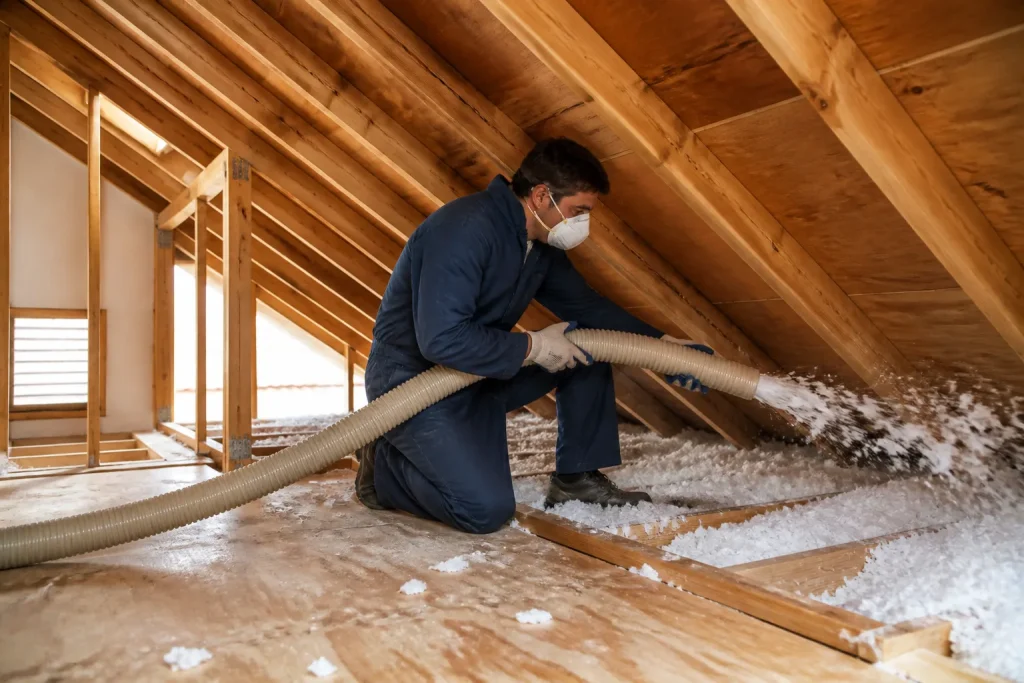
We regularly work in Northwood and Westpark attics where the roofline drops to three feet or less at the eaves. In those spaces, installers can’t stand upright. They work from kneeboards or crawl across joists, which slows everything down and raises the labor line item. That’s not a contractor padding the bill. That’s physics.
Compare that to a simple ranch home in, say, Riverside County with a single gable and a walkable attic floor. The square footage might be identical, but the Irvine job takes 40% longer to do correctly. Emerald Insulation home work across Orange County has shown us this pattern consistently, and it’s one reason national averages underpredict Irvine pricing.
Older homes in University Park and the Ranch add another variable: original batt insulation installed in the 1970s has usually compressed to half its rated R-value. If you’re topping off with blown-in, that’s straightforward. If the old material is damp, pest-damaged, or full of rat droppings, you’re looking at removal first, which adds disposal fees and labor.
Blown-In vs. Spray Foam: What’s Actually Worth Paying For in Irvine’s Climate
Here’s where material selection gets interesting. Irvine sits in climate zone 3C, which the building industry calls a “marine” climate. That means mild winters, warm summers, and relatively low humidity compared to coastal cities further south. It also means the payback math for high-end insulation products looks different here than it does in, say, Phoenix or Minnesota.
For most Irvine homes with conventional vented attics, blown-in fiberglass or cellulose at R-38 to R-49 delivers the best cost-to-performance ratio. We carry Owens Corning and Johns Manville fiberglass because they’re consistent products with solid warranties, and we carry GreenFiber cellulose because its recycled content and superior air-blocking char appeal to homeowners who want the eco-conscious option. But the honest answer is that for a standard vented attic in Irvine, the material matters less than the installation quality and the air sealing underneath it.
Spray foam is a different animal. We install Demilec open-cell and closed-cell systems because they solve problems blown-in can’t touch. If you’re converting an attic into conditioned storage, or if your ductwork runs through an unconditioned attic and you’re losing 20% to 30% of your cooling before it reaches the registers, spray foam on the roofline changes the game. It’s also the right call for homes where the attic houses mechanical equipment that’s susceptible to extreme heat. Closed-cell costs roughly double open-cell, but it adds structural rigidity and acts as a vapor barrier, which matters in specific scenarios.
The short version: spray foam is not automatically “better” just because it costs more. It’s better for specific conditions. Blown-in is better for others. The right material for your home’s specific conditions is the whole point of a proper assessment, not a one-size-fits-all pitch.
Title 24, Permits, and When Pulling One Saves You Money
California’s Title 24 energy code applies to insulation work in Irvine, and it catches some homeowners by surprise. Here’s what Title 24 means in practice for an attic insulation project in 2026:
- New insulation must meet minimum R-values for climate zone 3C: R-38 for most attics, R-30 in limited circumstances with specific conditions
- Any insulation project that triggers a building permit requires verification: a HERS rater or building inspector checks the installed depth and coverage
- Homeowners doing the work themselves must still comply: the code applies regardless of who installs the material
Irvine’s Building and Safety division pulls permits for insulation work when it’s part of a larger remodel, an addition, or when the project includes structural changes to the attic. A standalone insulation retrofit often doesn’t require one, but it depends on scope. Here’s where the cost-benefit gets interesting:
Pulling a permit adds $150 to $400 in fees and requires scheduling an inspection. Some contractors quote cash jobs without permits to keep the number lower. But a permitted job creates a record that the work met code, which matters when you sell the house. Buyers and real estate agents in Irvine increasingly ask about insulation and energy upgrades as part of the disclosure process. A permitted project with documentation is a selling point. An unpermitted one can become a negotiation liability.
There’s another angle: Title 24 compliance documentation can strengthen a 25C tax credit claim. The IRS wants to see that the work met applicable building codes. A permit and inspection record is exactly the kind of paper trail that makes a credit claim clean.
The Real Payback Window for Irvine Homeowners
National insulation guides throw around payback periods of two to five years. For Irvine, the math works differently because our energy costs and consumption patterns are unusual. Here’s what actually drives the payback calculation here:
- SCE rate tiers: Southern California Edison’s tiered pricing means that the highest-cost kilowatt-hours are the ones you use during summer afternoons when attic heat loads peak. Insulation that cuts afternoon cooling demand cuts your use of the most expensive power first.
- Coastal temperature moderation: Homes in Irvine don’t need as much heating as inland cities, so the wintertime savings are smaller. The summer cooling savings are where the payback comes from.
- Ductwork location: Many Irvine homes route HVAC ducts through the attic. In summer, the attic can hit 130 degrees, and the ducts are losing cold air before it reaches your living space. Insulating the attic floor or the roofline directly addresses this loss, and that’s where the fastest payback shows up.
For a typical Irvine home that spends $2,600 a year on electricity, a well-executed attic insulation upgrade with air sealing typically cuts cooling costs by 15% to 25%. That’s roughly $300 to $500 in annual savings, which puts the payback on a $2,800 job at six to nine years. Not a home-run return, but that’s the honest math. Where the calculation changes is comfort: the second floor staying within three degrees of the first floor, no hot bedrooms in August, no cold drafts from the ceiling in January. Those aren’t line items on an SCE bill, but they’re the reason most Irvine homeowners tell us the project was worth it.
The 25C Tax Credit: What You Can Claim in 2026
The Inflation Reduction Act’s 25C tax credit survived into 2026, and it applies to attic insulation as long as you meet the documentation requirements. Here’s what Irvine homeowners need to know:
- The credit is 30% of the material cost, with a $1,200 annual cap for insulation and air sealing combined
- Labor is not included in the credit calculation, only materials
- The insulation must meet current IECC standards for your climate zone, which aligns with Title 24 requirements
- Your contractor must provide an itemized invoice that separates material costs from labor, includes the product brand and R-value, and states that the installation meets applicable building codes
The most common mistake we see is homeowners claiming the full project cost and getting caught in an audit. The IRS is specific: 30% of materials, labor excluded, capped at $1,200 per year for insulation and air sealing. If your $4,000 attic insulation job includes $1,600 in materials, your credit is $480. Not life-changing, but worth claiming.
Ask your contractor before signing whether they can provide a 25C-compliant invoice. If they can’t separate materials from labor, or if they won’t specify the R-value and product brand in writing, move on. You need that documentation to file Form 5695 with your federal return.
One more thing: Attic Insulation in Stanton work involves similar documentation requirements, and while we primarily serve Irvine, we’ve helped homeowners throughout central Orange County navigate the 25C paperwork. If you’re near the Stanton-Huntington Beach border, the same rules apply.
When to Call a Pro
Attic insulation sits at the intersection of three things homeowners shouldn’t mess with: the risk of falling through a ceiling, the potential for compressed insulation to create moisture problems, and the code compliance issues we just covered. A DIY blown-in job might save you $800 in labor, but if you seal the attic floor incorrectly or miss the air bypasses around recessed lights and bathroom fans, you’ve paid for material that’s performing at half its rated value.
Plus, there’s the comfort factor. We pulled a DIY fiberglass job out of a University Park attic last year where the homeowner had blown R-30 over a badly sealed attic floor. The material was fine. The air sealing was nonexistent. The house was still hot upstairs, and the fix cost more than doing it right the first time.
If you’re in Irvine and want a free estimate with line-item pricing you can actually compare against other quotes, call (855) 490-8655. We’ll walk the attic, check what’s actually up there, and tell you what version of this job your house needs. Related services we handle include Spray Foam Insulation in Stanton and Blown In Insulation in Stanton, both done with the same material-specific approach we use on every Irvine attic.
The Bottom Line
Attic insulation pricing in Irvine varies by $1,200 or more for the same square footage because the scope of work legitimately varies. Material choice matters, but air sealing, existing insulation removal, attic access difficulty, and permit requirements are the real swing factors. Blown-in fiberglass or cellulose at R-38 to R-49 delivers the best value for most Irvine homes with vented attics. Spray foam earns its premium when ducts run through the attic or when you’re converting the space. The 25C tax credit helps, but only with proper documentation. And Title 24 compliance isn’t optional, even if a permit isn’t always required.
If you’re in Irvine and want a straight answer on what your attic actually needs and what it should cost, Emerald Insulation offers free estimates with line-item breakdowns. Call (855) 490-8655 to schedule a walkthrough.
Frequently Asked Questions
Attic insulation in Irvine typically costs between $1,800 and $5,400 depending on attic size, material choice, whether old insulation needs removal, and whether air sealing is included. Blown-in fiberglass without removal or air sealing starts around $1,800 for a 2,000 square foot home, while full closed-cell spray foam on the roofline can exceed $10,000. Call (855) 490-8655 for a line-item quote on your specific home.
Spray foam is worth the premium in Irvine when ductwork runs through an unconditioned attic, when the attic is being converted to conditioned storage, or when mechanical equipment sits in the attic space. For standard vented attics with the HVAC below, blown-in fiberglass or cellulose at R-38 to R-49 typically offers better return on investment. Call (855) 490-8655 for an assessment of your attic’s specific setup.
Standalone attic insulation retrofits often don’t require a City of Irvine building permit, but any project that’s part of a larger remodel, addition, or structural change does. Title 24 energy code compliance applies regardless of permitting. Permitted work costs $150 to $400 more in fees but creates a code-compliant record that helps at resale and supports 25C tax credit claims. Call (855) 490-8655 to determine what your project needs.
Irvine homeowners typically see 15% to 25% savings on cooling costs after a proper attic insulation upgrade with air sealing, translating to roughly $300 to $500 per year for an average SCE customer. The savings come primarily from reduced summer afternoon cooling load when SCE’s highest rate tiers apply. Call (855) 490-8655 for an honest assessment of your home’s potential savings.
Written by the team at Emerald Insulation, serving Irvine since 2018.
Need Insulation Help?
Call Emerald Insulation — licensed & insured, here with fast after-hours help in Stanton.
(855) 490-8655