
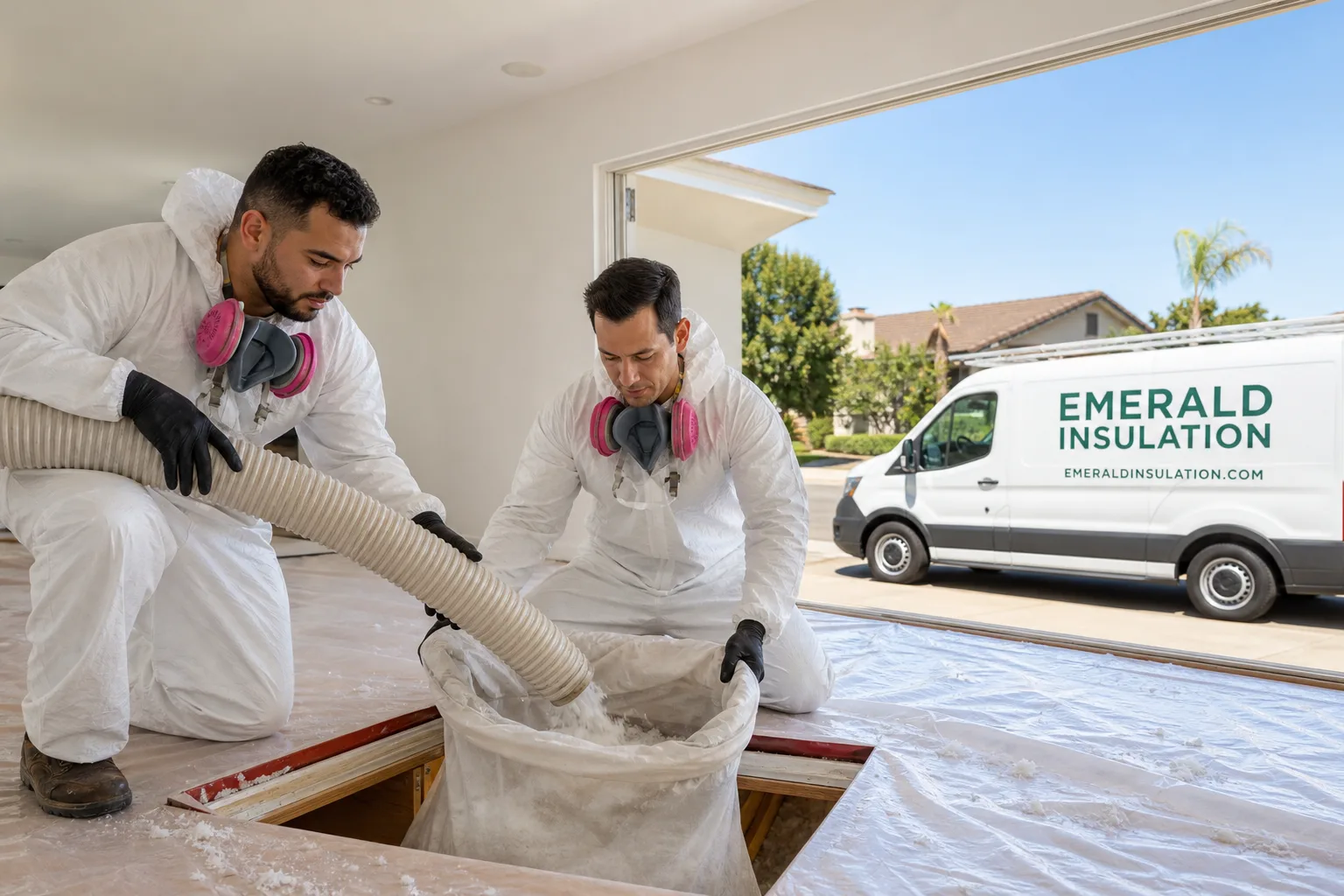
Fast, Reliable Spray Foam Insulation Across Portola Hills
Spray foam insulation in Portola Hills typically runs $2.50 – $6.50 per board foot installed, with a full attic retrofit on a 1980s-90s tract home landing between $4,800 and $12,500 depending on foam type and roof-deck scope. If you’re on a canyon-facing street near the Cleveland National Forest boundary, open-cell is usually the budget-friendly air-sealing choice, but closed-cell is what gets you the Class A fire-rated roof deck your Chapter 7A inspection wants to see. We’ve worked on homes off Saddleback Ranch Road, Canyon Rim Drive, and throughout ZIP 92610, and we know exactly what those attics look like when the Santa Anas have been working on them for three decades. Call (855) 490-8655 and we’ll give you a straight read on what your Portola Hills home actually needs.
Why Emerald Insulation Is Portola Hills’s Preferred Spray Foam Insulation Company
Portola Hills isn’t like the flatlands of Irvine or the coastal strip of Laguna. This is a foothill community where the sun hammers rooftops at 100°F-plus all summer, and the Santa Anas push embers and heat against canyon-facing walls every fall. We carry Icynene and Demilec spray foam systems because those two manufacturers build products that handle both aggressive heat gain and the fire-resistance demands that Portola Hills uniquely faces. Most inland OC insulation crews don’t stock Chapter 7A ember-resistant vents or understand how they pair with foam on a roof deck. We do, because we’ve done enough defensible-space retrofits in Portola Hills to know the inspection points cold.
Noel Cartagena leads our crew, and he’s built Emerald Insulation around one idea: match the material to the job, not the job to whatever’s on the truck. That’s how we can offer you eight brands across fiberglass, mineral wool, spray foam, and cellulose, and still give you a clear recommendation instead of a sales pitch. Portola Hills homeowners call us because they want a contractor who can explain why closed-cell makes sense on a low-pitch tile roof attic and open-cell is fine for a rim joist in a garage. We answer the phone, we show up when we say we will, and we bring the materials your specific street needs.
Spray Foam Insulation Contractors in Portola Hills
Spray Foam Insulation Contractors in Portola Hills do more than spray foam. We evaluate your attic’s existing insulation, its venting, and its wildfire compliance before we ever pull a hose. In this ZIP code, that evaluation matters more than in most of Orange County. A typical open-cell spray foam job on a Portola Hills garage ceiling or rim joist runs $1,200 – $3,800. A full closed-cell roof deck encapsulation on a two-story hillside tract home runs $7,500 – $12,500. Those aren’t the cheapest numbers in the county, and that’s intentional. Spray foam in Portola Hills has to do more than insulate. It has to hold up under heat that melts cheaper materials and it has to pass inspection under fire codes most contractors never read.
Closed-Cell for Roof Decks and Wildfire Zones
Closed-cell foam is the workhorse for Portola Hills attics. It adds structural strength, seals against air movement, and carries Class A fire ratings when applied correctly. If your attic has standard soffit and gable vents that would fail an ember test, closed-cell on the roof deck plus ember-resistant vents is the fix that passes Chapter 7A without ripping apart your whole exterior. We carry Demilec and Icynene closed-cell products specifically because they perform in the heat loads Portola Hills gets from July through October.
Open-Cell for Interior Air Sealing and Sound
Open-cell spray foam is softer, more affordable per board foot, and excellent for interior walls, rim joists, and sound dampening. On steep lots where a wall backs against a garage or hillside, open-cell can handle the air-sealing side of the job without the cost of closed-cell. We’ll tell you honestly which one fits your budget and your street’s fire exposure. Sometimes the answer is open-cell on the walls and closed-cell on the roof deck. That’s the kind of material-matching we do every week in Portola Hills.
Spray Foam Attic Insulation in Portola Hills
Spray Foam Attic Insulation in Portola Hills is a different job than it is in Irvine or Mission Viejo because your attic is likely shallow, low-pitch, and fighting decades of Santa Ana dust intrusion. On a 1989 two-story tract home off Saddleback Ranch Road, we found original R-19 batts compressed to R-6 under wind-driven dust and dryer-vent heat. The attic was vented with standard soffit and gable vents that failed ember resistance. We removed the failed batts, air-sealed the top plates and can lights, applied 2 inches of closed-cell Icynene to the roof deck for a Class A assembly, and swapped in Chapter 7A ember-resistant vents. The homeowner immediately noticed fewer 100°F-plus afternoon heat spikes and passed the defensible-space inspection without retrofitting the whole exterior.
That’s the conversion we do most for Portola Hills homes: legacy attic to code-compliant, air-sealed, ember-resistant foam assembly. The cost for that full conversion on a typical 1,800 – 2,400 square foot two-story runs $6,800 – $11,800. It’s an investment that pays back in lower summer cooling bills and better fire protection.
When Open-Cell Makes More Sense in Portola Hills Attics
If your home sits on the inland side of Portola Hills, away from the canyon edge and the worst ember exposure, open-cell foam on the attic floor may be enough. It air-seals the living space below and keeps conditioned air from leaking into the attic. Runs $2.50 – $3.80 per board foot. You still need to address venting, but the fire-rating pressure is lower than on the canyon side.
When Closed-Cell Is the Right Call for Chapter 7A
Streets that back up to the Cleveland National Forest, or any home that faces the 241 corridor during a Santa Ana event, should seriously consider closed-cell on the roof deck. It creates the non-combustible assembly the fire marshal wants to see. Cost is higher, $3.90 – $6.50 per board foot, but it’s often the only way to pass defensible-space inspection without replacing vents, roof underlayment, and soffit materials separately. We carry the Icynene and Demilec closed-cell systems and the Chapter 7A vents to complete the job as one package.
Trusted Brands We Service in Portola Hills
We stock Icynene and Demilec spray foam systems because Portola Hills demands products with proven heat and fire performance. For homes where mineral wool makes more sense than foam, we carry Rockwool, which gives you fire resistance, soundproofing, and moisture resistance in one batt. For attics where blown-in is the better answer, GreenFiber cellulose is in our lineup for homeowners who want a high-recycled-content option instead of foam. We’re not married to any one brand. We’re married to the right material for your house. That’s the Spray Foam Insulation philosophy we bring to every Portola Hills job: carry the best from each category and let the house tell us what it needs.
Common Spray Foam Insulation Problems We See in Portola Hills Homes
- Original R-19 batts crushed to R-6. The 1980s-90s hillside tracts off Saddleback Ranch Road and Canyon Rim Drive were built with R-19 fiberglass that Santa Ana winds and decades of dryer-vent heat have compressed into the R-6 to R-8 range. That leaves hot spots directly over bedrooms and living rooms. We find this in most Portola Hills homes that haven’t been re-insulated since construction.
- Standard soffit and gable vents that fail ember resistance. Canyon-facing walls get hammered by wind-driven embers every Santa Ana event. Standard vents let those embers into the attic. Chapter 7A requires ember-resistant vents. We address this on every Portola Hills spray foam job because the foam won’t protect you if the vents are leaking fire into the attic.
- Spray foam applied directly over settled cellulose or dirty decking. Tight, low-pitch attics collect dust and debris fast. If foam goes on top of that without air-sealing and cleaning first, adhesion fails and moisture traps between the layers. We see failed spray foam jobs in Portola Hills where a previous contractor skipped the prep work. We don’t skip it.
- Partially conditioned walls against hillsides and garages. Steep lots mean some walls are buried against grade or exposed to garage heat on one side. Those walls leak air in ways a flat-lot tract home in Lake Forest never does. We evaluate those wall assemblies specifically before recommending foam type and depth. It’s not always about R-value. Air-sealing details matter just as much here.
Pricing for Spray Foam Insulation in Portola Hills, CA
Here are honest numbers for Portola Hills as of 2026. Open-cell spray foam runs $2.50 – $3.80 per board foot installed. Closed-cell runs $3.90 – $6.50 per board foot installed. A garage ceiling or rim joist job typically lands at $1,200 – $3,800. A full attic conversion with air-sealing, closed-cell roof deck foam, and Chapter 7A vent replacement on a two-story tract home runs $6,800 – $12,500 depending on square footage and how much old insulation has to be removed. Homes on canyon-facing streets with heavy ember exposure usually land at the higher end because they need the full fire-rated assembly. We do free estimates. Call (855) 490-8655 and we’ll come out to Portola Hills, walk your attic, and give you a written quote that same visit.
We Also Serve Cities Near Portola Hills
We work throughout the Saddleback foothills and inland South OC, including Foothill Ranch, Lake Forest, Mission Viejo, and Trabuco Canyon. If you’re in one of those areas and want a contractor who understands wildfire codes and legacy attics, Spray Foam Insulation in Portola Hills is the same team that handles those jobs. We bring the same materials, the same crews, and the same straight answers to every ZIP in the 241 corridor.
Serving Portola Hills, CA — Our Local Coverage Area
We’re based in the Portola Hills area and know this community well. Use the map below to see our service coverage — if you’re nearby, we can almost certainly help.
FAQs About Spray Foam Insulation in Portola Hills
Yes. Portola Hills falls under Chapter 7A wildfire building codes, which means attic vents must be ember-resistant. Standard soffit and gable vents fail ember tests and can void your defensible-space compliance. Spray foam doesn’t replace that requirement; it works alongside it. On a canyon-facing street, we pair closed-cell foam on the roof deck with ember-resistant vents as a single assembly. That’s the combination the fire inspection wants to see. Call (855) 490-8655 and we’ll check your current vents against Chapter 7A before we quote anything.
No. The original R-19 batts in Portola Hills tract homes are usually compressed to R-6 or R-8 by Santa Ana wind-driven dust and decades of dryer-vent heat. Spraying foam over them locks in that failure and creates adhesion problems. We remove the failed batts first, air-seal the top plates and can lights, then apply foam to a clean surface. Skipping that step is the most common reason spray foam fails in 1980s-90s foothill tract homes. Call (855) 490-8655 for an attic inspection. Estimates are free.
Closed-cell spray foam adds R-6.5 to R-7 per inch, and open-cell adds R-3.5 to R-4 per inch. In a tight, low-pitch Portola Hills attic where headroom is minimal, 2 inches of closed-cell on the roof deck delivers about R-13 to R-14 plus the air-sealing and fire-rating benefits. That’s often enough to meaningfully change summer heat gain in a 100°F-plus afternoon. For comparison, the original R-19 batts were only R-19 on paper and usually measure R-6 to R-8 after thirty years of Santa Ana abuse. Call (855) 490-8655 and we’ll measure what you actually have before recommending a target.
Spray foam doesn’t block embers directly. It does two things: closed-cell foam on the roof deck creates a non-combustible, Class A fire-rated assembly that resists ignition from above, and it forces you to address venting before the job is finished. When we install foam in Portola Hills, we also swap standard soffit and gable vents for Chapter 7A ember-resistant models. The combination is what stops wind-driven embers from turning your attic into a firebox. Most inland OC insulation contractors never touch the vent side. We do. That’s the difference for a canyon-adjacent Portola Hills home. Call (855) 490-8655 to check your vents and foam as a package.
Yes, and in most cases open-cell is the right fit for those walls. On steep Portola Hills lots, walls built against grade or against a garage experience different thermal and moisture conditions than above-grade walls. Open-cell foam air-seals those assemblies without trapping moisture the way closed-cell can against grade contact. We evaluate each wall separately because a one-size-fits-all answer is wrong. Some walls need closed-cell, some need open-cell, and some need mineral wool instead. That’s exactly the kind of material matching we do for Portola Hills homes. Call (855) 490-8655 and we’ll walk the lot with you.
Written by Noel Cartagena, Owner at Emerald Insulation, serving Portola Hills and surrounding Orange County foothill communities.